

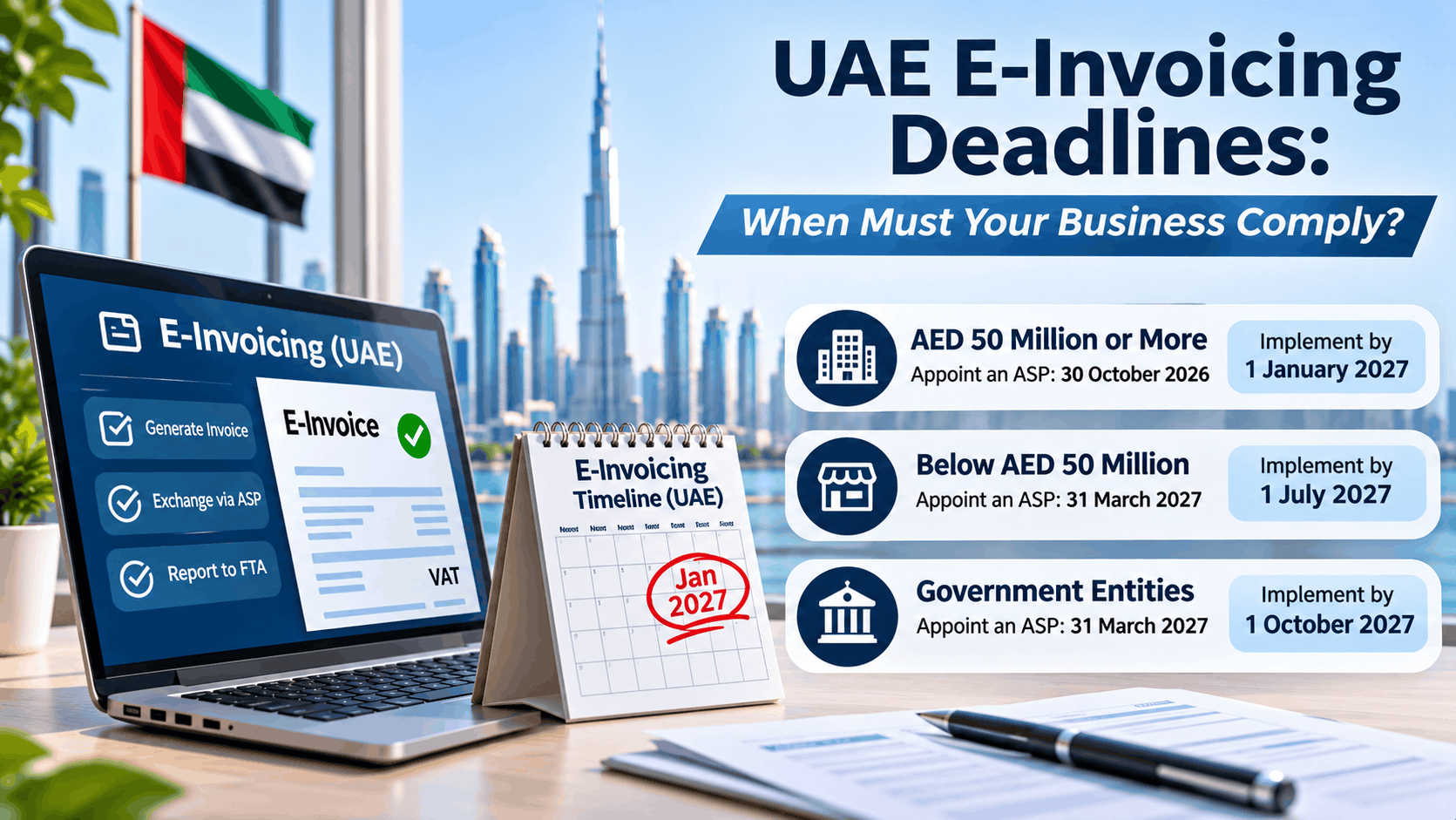
Understanding the UAE E-Invoicing Deadlines is an important first step in this transition.
The UAE Ministry of Finance has introduced a phased implementation schedule based on annual revenue and the type of entity. Businesses must comply with two important milestones: appointing an Accredited Service Provider (ASP) and implementing the Electronic Invoicing System.
For larger businesses, the deadline to appoint an ASP has already passed, while mandatory implementation begins on 1 January 2027.
Smaller businesses have additional time, but preparing early can help avoid implementation delays, operational difficulties and potential compliance risks.
This article explains the UAE e-invoicing implementation timeline, the businesses affected, important regulatory requirements and the practical steps companies should take before their respective deadlines.
1. What Is UAE E-Invoicing?
Electronic invoicing, commonly referred to as e-invoicing, involves issuing, exchanging and processing invoices in a structured electronic format that allows automated interpretation and processing.
Under the UAE’s framework, electronic invoices are exchanged between suppliers and buyers through Accredited Service Providers, with relevant tax information reported electronically to the Federal Tax Authority (FTA).
Unlike conventional invoicing, a PDF invoice sent by email does not qualify as an electronic invoice merely because it is transmitted digitally.
Similarly, scanned invoices, Word documents and image files do not independently satisfy the structured electronic invoicing requirements.
The UAE framework requires qualifying invoices to be processed using the prescribed electronic invoice format and exchange procedures.
The introduction of e-invoicing is intended to support:
- Improved invoice processing efficiency
- Greater accuracy in transaction information
- Reduced manual data entry
- Enhanced tax compliance
- Better financial transparency
- Digital transformation of business processes
Businesses should therefore assess whether their existing accounting and invoicing arrangements can support the new requirements.
2. UAE E-Invoicing Deadlines: Important Dates for Businesses
The UAE has adopted a phased approach to mandatory e-invoicing implementation.
The implementation schedule was introduced under Ministerial Decision No. 244 of 2025 and subsequently amended by Ministerial Decision No. 66 of 2026.
The applicable deadlines are:
| Business Category | Deadline to Appoint an ASP | Mandatory Implementation Date |
|---|---|---|
| Businesses with annual revenue of AED 50 million or more | 30 October 2026 | 1 January 2027 |
| Businesses with annual revenue below AED 50 million | 31 March 2027 | 1 July 2027 |
| Government entities within scope | 31 March 2027 | 1 October 2027 |
The pilot programme and voluntary implementation commenced on 1 July 2026.
Why Are There Two Separate Deadlines?
Businesses must distinguish between the deadline for appointing an ASP and the mandatory implementation date.
ASP Appointment Deadline: The date by which a business must appoint an Accredited Service Provider under the applicable regulations.
Mandatory Implementation Date: The date by which the business must implement the Electronic Invoicing System and comply with the relevant operational requirements.
Appointing an ASP does not, by itself, mean that the business has completed its e-invoicing implementation.
Companies must also establish the required invoice exchange processes, prepare their systems and ensure operational readiness.
3. Phase 1: E-Invoicing Deadline for Businesses With Revenue of AED 50 Million or More
Businesses subject to the e-invoicing framework with annual revenue equal to or exceeding AED 50 million fall within the first mandatory implementation phase.
The applicable deadlines are:
- ASP Appointment Deadline: 30 October 2026
- Mandatory Implementation Date: 1 January 2027
The original ASP appointment deadline was 31 July 2026. However, Ministerial Decision No. 66 of 2026 extended this deadline to 30 October 2026.
The mandatory implementation date of 1 January 2027 remains unchanged.
What Should Large Businesses Do Now?
As the ASP appointment deadline has passed, businesses within this category should review their compliance status and implementation readiness.
Important activities include:
- Confirming the appointment of an Accredited Service Provider
- Completing the necessary ASP onboarding arrangements
- Reviewing accounting and ERP system capabilities
- Verifying customer and supplier information
- Establishing the electronic invoice exchange process
- Testing electronic invoices and credit notes
- Reviewing incoming invoice processing
- Training relevant employees
- Establishing procedures for handling rejected invoices and processing errors
Businesses that have not completed the required ASP appointment should address the matter promptly and seek appropriate professional guidance.
With mandatory implementation approaching, companies should prioritise operational readiness rather than postponing system testing until the final weeks.
4. Phase 2: E-Invoicing Deadline for Businesses With Revenue Below AED 50 Million
Businesses subject to the framework with annual revenue below AED 50 million fall within the second implementation phase.
The applicable deadlines are:
- ASP Appointment Deadline: 31 March 2027
- Mandatory Implementation Date: 1 July 2027
This category is particularly relevant to small and medium-sized enterprises operating in Dubai and across the UAE.
Although these businesses have additional preparation time, they should begin evaluating their e-invoicing requirements well before the prescribed deadlines.
Why Should SMEs Prepare Early?
Many smaller businesses rely on basic accounting applications, spreadsheets or manual invoice-processing procedures.
Transitioning to structured electronic invoicing may require adjustments to existing workflows, invoice data and accounting processes.
Early preparation allows businesses to:
- Understand their regulatory obligations
- Evaluate existing invoicing arrangements
- Identify missing invoice information
- Compare available ASP services
- Assess implementation costs
- Establish appropriate internal procedures
- Train employees before mandatory implementation
Businesses should avoid assuming that e-invoicing implementation can be completed immediately after selecting a service provider.
The time required will depend on the company’s existing systems and operational complexity.
5. Phase 3: E-Invoicing Deadline for Government Entities
Government entities within the scope of the UAE Electronic Invoicing System are subject to a separate implementation phase.
The applicable deadlines are:
- ASP Appointment Deadline: 31 March 2027
- Mandatory Implementation Date: 1 October 2027
The inclusion of government entities forms part of the UAE’s broader digital transformation framework.
Businesses supplying goods or services to government entities should also assess whether their invoicing processes are suitable for the applicable B2G electronic invoicing requirements.
6. How Is Annual Revenue Determined for UAE E-Invoicing?
The applicable implementation phase depends on the business’s revenue as defined under the relevant legislation.
For this purpose, revenue generally refers to gross income earned during the most recent accounting period, based on financial statements prepared in accordance with applicable UAE legislation.
Where such financial statements are unavailable, other documentation acceptable to the FTA may be relevant.
Is the AED 50 Million Threshold Based on Profit?
No.
The threshold relates to revenue rather than net profit.
For example, a business generating AED 60 million in annual revenue would generally fall within the first implementation phase if it is subject to the framework, regardless of whether its net profit is relatively low.
Businesses should review the applicable revenue definition and supporting financial information when determining their implementation phase.
7. Which Businesses Must Comply With UAE E-Invoicing?
The UAE e-invoicing framework generally applies to qualifying business transactions involving persons conducting business in the UAE.
The initial mandatory framework primarily covers:
- Business-to-Business (B2B) transactions
- Business-to-Government (B2G) transactions
Businesses across different sectors may be affected, including:
- Trading companies
- Manufacturing businesses
- Professional service providers
- Commodity trading businesses
- Real estate companies
- Importers and exporters
- Wholesale businesses
- Free zone companies
- Small and medium-sized enterprises
- Large corporate organisations
Applicability must be assessed based on the relevant legislation, business activities, transaction types and prescribed exclusions.
Are Free Zone Companies Required to Comply?
Free zone companies are not automatically exempt from UAE e-invoicing.
Businesses operating in DMCC, JAFZA, DAFZA and other UAE free zones should evaluate their obligations based on the nature of their transactions and the applicable requirements.
Is E-Invoicing Mandatory for Businesses That Are Not VAT Registered?
VAT registration status alone does not determine whether a business falls within the e-invoicing framework.
Businesses should assess the applicable requirements rather than assuming that the absence of VAT registration automatically excludes them.
What About Business-to-Consumer Transactions?
Business-to-Consumer (B2C) transactions are outside the initial mandatory implementation scope under the published framework.
Businesses conducting both B2B and B2C transactions should identify which transactions are covered.
Businesses exclusively conducting B2C transactions should also consider the specific exclusion provisions applicable to their circumstances.
8. What Is an Accredited Service Provider and Why Is the Appointment Deadline Important?
An Accredited Service Provider is a service provider approved under the UAE e-invoicing accreditation framework.
ASPs facilitate the exchange of structured electronic invoices and support the prescribed reporting of tax information.
Their responsibilities may include:
- Receiving invoice information from businesses
- Validating electronic invoice data
- Converting data into the prescribed format, where applicable
- Facilitating invoice exchange between suppliers and buyers
- Supporting electronic tax data reporting
- Communicating relevant processing and validation statuses
Businesses within the mandatory scope must appoint an ASP in accordance with the applicable deadlines.
What Should Businesses Consider When Selecting an ASP?
Important considerations include:
- Accreditation status
- Compatibility with existing accounting systems
- Technical onboarding requirements
- Invoice processing capacity
- Pricing structure
- Data security arrangements
- Technical support
- Implementation assistance
- Business continuity arrangements
The appropriate ASP should be selected based on the company’s operational requirements, transaction volumes and existing technology environment.
9. What Happens If a Business Misses the UAE E-Invoicing Deadline?
Businesses that fail to meet the applicable e-invoicing requirements may face administrative penalties.
The FTA has clarified that an administrative penalty of AED 5,000 for each month or part thereof of delay may apply to failure to implement the Electronic Invoicing System, including failure to appoint an ASP within the prescribed deadline.
Other violations may be subject to separate penalties under the applicable legislation.
Beyond potential penalties, delayed implementation can create practical difficulties, including:
- Disruption to invoice processing
- Additional implementation costs
- Delays in exchanging invoices
- Incomplete invoice data
- Difficulties in processing supplier invoices
- Increased manual intervention
- Reconciliation challenges
Businesses should therefore consider regulatory compliance and operational readiness together.
Is Your Business Ready for the UAE E-Invoicing Deadline?
AVS Lewis & Pecker Auditing can assist your business with understanding its e-invoicing obligations, reviewing existing processes and preparing for mandatory implementation.
Our team can help identify compliance gaps and recommend a practical implementation approach suited to your business operations.
10. Does Your Business Need to Replace Its Accounting Software Before the Deadline?
One of the common concerns surrounding UAE e-invoicing implementation is whether businesses must replace their existing accounting or ERP software.
Replacing the entire accounting system is not necessarily required.
The appropriate approach depends on the capabilities of the existing system, the quality of invoice data and the technical arrangements available with the appointed ASP.
Some businesses may be able to continue using their existing software with suitable adjustments or additional invoice-processing arrangements.
Others may require more extensive changes.
Before selecting an implementation approach, businesses should review:
- Existing accounting software capabilities
- Required invoice data
- Customer and supplier information
- Invoice generation and approval processes
- Available data exchange methods
- ASP technical requirements
- Transaction volumes
- Internal control procedures
The objective should be to establish a compliant and practical electronic invoicing process without introducing unnecessary disruption.
For a more detailed explanation, businesses can refer to our article, UAE E-Invoicing Implementation: A Complete Guide for Businesses.
11. UAE E-Invoicing Readiness Checklist Before the Deadline
Businesses preparing for mandatory implementation should consider the following checklist:
- Confirm whether the business falls within the e-invoicing framework
- Identify the applicable implementation phase
- Verify annual revenue for determining the relevant deadline
- Review B2B and B2G transactions
- Identify applicable exclusions
- Review existing invoicing procedures
- Assess accounting and ERP systems
- Verify customer and supplier information
- Identify missing mandatory invoice data
- Evaluate and appoint an Accredited Service Provider
- Complete the required onboarding arrangements
- Establish the electronic invoice exchange process
- Test electronic invoices and credit notes
- Review incoming invoice processing
- Define responsibilities for handling errors and rejected invoices
- Train relevant employees
- Review record retention and data security controls
- Establish ongoing monitoring procedures
Completing these activities before mandatory implementation can help businesses identify gaps and reduce operational risks.
12. Important UAE E-Invoicing Regulatory Updates in 2026
Businesses should ensure that their implementation plans reflect the latest applicable regulatory requirements.
Several developments during 2026 are particularly relevant.
Extension of the ASP Appointment Deadline
Ministerial Decision No. 66 of 2026 extended the ASP appointment deadline for businesses with annual revenue of AED 50 million or more from 31 July 2026 to 30 October 2026.
The mandatory implementation date of 1 January 2027 was not changed.
Temporary Exclusion for Certain Tax Group Transactions
Ministerial Decision No. 197 of 2026 introduced a temporary exclusion for business transactions between members of the same Tax Group.
The exclusion applies for 24 months commencing on 1 January 2027.
Businesses should evaluate whether their transactions qualify for this exclusion rather than assuming that all related-party transactions are exempt.
Changes to Electronic Invoice Data Storage Requirements
The October 2026 amendments removed the previous general requirement to store electronic invoice data within the UAE.
However, businesses must continue to retain electronic invoices, electronic credit notes and associated information for the applicable statutory period and ensure that the records can be provided to the FTA upon request.
Changes to System Failure Notification Provisions
The amendments also removed the previous specific provisions requiring notification of certain system failures within two business days.
Businesses should nevertheless maintain appropriate operational controls and procedures for addressing processing interruptions.
Updated ASP Accreditation Framework
Ministerial Decision No. 168 of 2026 introduced an updated accreditation framework for e-invoicing service providers.
Businesses should verify that their proposed ASP holds the required accreditation under the applicable framework.
These developments demonstrate the importance of monitoring official Ministry of Finance and FTA publications throughout the implementation process.
13. How AVS Lewis & Pecker Auditing Can Assist With UAE E-Invoicing Compliance
AVS Lewis & Pecker Auditing provides professional advisory and compliance services to businesses operating in Dubai and across the UAE.
Our e-invoicing advisory services are designed to help companies understand their regulatory obligations and prepare for the transition to the UAE Electronic Invoicing System.
Depending on the company’s requirements, our assistance may include:
- E-invoicing applicability assessment
- Identification of relevant implementation deadlines
- Review of existing invoicing procedures
- E-invoicing readiness assessment
- Identification of implementation gaps
- Review of invoice data requirements
- Evaluation of available implementation approaches
- Guidance on ASP selection
- Coordination of implementation activities
- Employee awareness and process guidance
Our approach focuses on helping businesses understand their obligations and identify practical implementation arrangements suited to their existing operations.
14. AVS EIS – E-Invoicing Solution
As mandatory e-invoicing deadlines approach, businesses should also evaluate how their existing accounting processes can support the transition.
AVS EIS is an e-invoicing solution developed to support businesses preparing for electronic invoicing.
It provides an additional option for businesses evaluating their invoicing processes and technology requirements.
Businesses should assess the suitability of AVS EIS based on their existing software, invoice volumes, operational requirements and arrangements with an appointed ASP.
AVS EIS should not be confused with an Accredited Service Provider.
The applicable electronic invoice exchange and tax reporting obligations must be fulfilled through the prescribed ASP framework.
Businesses interested in evaluating AVS EIS can contact our team to learn more about the solution.
Explore AVS EIS – E-Invoicing Solution
Discover AVS EIS, an e-invoicing solution developed to support businesses evaluating their transition to electronic invoicing.
Learn more about AVS EIS and assess whether it is suitable for your company’s existing accounting processes and operational requirements.
Frequently Asked Questions
When is e-invoicing mandatory in the UAE?
Mandatory e-invoicing implementation begins on 1 January 2027 for businesses within scope with annual revenue of AED 50 million or more. Businesses below this threshold must implement by 1 July 2027, while government entities within scope must implement by 1 October 2027.
What is the UAE e-invoicing deadline for small businesses?
Businesses within scope with annual revenue below AED 50 million must appoint an Accredited Service Provider by 31 March 2027 and implement the Electronic Invoicing System by 1 July 2027.
What is the e-invoicing deadline for large companies in the UAE?
Businesses within scope with annual revenue equal to or exceeding AED 50 million were required to appoint an ASP by 30 October 2026 and must implement the system by 1 January 2027.
Has the UAE e-invoicing deadline been extended?
The ASP appointment deadline for businesses with annual revenue of AED 50 million or more was extended from 31 July 2026 to 30 October 2026. The mandatory implementation date of 1 January 2027 remained unchanged.
Is UAE e-invoicing mandatory for free zone companies?
Free zone status does not automatically exempt a business from the UAE e-invoicing framework. Applicability depends on the company’s activities, relevant transactions and regulatory requirements.
Is e-invoicing mandatory for businesses that are not VAT registered?
VAT registration status alone does not determine whether a business is subject to e-invoicing. Businesses should assess their obligations under the applicable legislation.
What is the difference between an ASP appointment deadline and an implementation deadline?
The ASP appointment deadline is the date by which a business must appoint an Accredited Service Provider. The implementation deadline is the date by which the business must establish and operate the Electronic Invoicing System in accordance with the applicable requirements.
What happens if a business misses the e-invoicing deadline?
Failure to comply with prescribed deadlines may result in administrative penalties. The FTA has clarified that a penalty of AED 5,000 per month or part thereof may apply to relevant delays, including failure to appoint an ASP within the prescribed deadline.
Can businesses continue using PDF invoices after mandatory implementation?
PDF invoices alone do not satisfy the UAE’s structured electronic invoicing requirements for transactions within the mandatory framework. Businesses must comply with the prescribed electronic invoice format and exchange procedures.
Does a business need to replace its existing accounting software?
Not necessarily. The appropriate implementation approach depends on the capabilities of the existing software, invoice data requirements and the technical arrangements needed to exchange information through an ASP.
Can businesses implement e-invoicing before their mandatory deadline?
Yes. Voluntary implementation commenced on 1 July 2026, subject to the applicable technical and regulatory requirements.
How can businesses prepare for mandatory e-invoicing?
Businesses should identify their applicable deadlines, review existing invoicing processes, assess accounting systems, verify invoice data, appoint an appropriate ASP, test electronic invoice processing and train relevant employees before implementation.
Conclusion
The introduction of mandatory electronic invoicing represents an important development in the UAE’s financial and tax administration framework.
With implementation beginning in January 2027 for larger businesses and extending to smaller businesses and government entities later in the year, companies should understand their obligations and prepare according to the applicable deadlines.
Importantly, UAE E-Invoicing Compliance involves more than simply appointing an Accredited Service Provider.
Businesses must also review their existing invoicing processes, evaluate accounting systems, maintain accurate invoice data and establish appropriate electronic invoice exchange arrangements.
Early preparation can help businesses identify implementation challenges, manage costs and reduce operational disruption.
By developing a structured implementation plan, companies can approach the transition to mandatory e-invoicing with greater confidence.
Need Assistance With UAE E-Invoicing Implementation?
AVS Lewis & Pecker Auditing assists businesses with understanding their e-invoicing requirements, assessing implementation readiness and preparing for compliance.
Whether your business falls within the January 2027 or July 2027 implementation phase, our team can help you evaluate your requirements and identify a practical approach.
Request an E-Invoicing Consultation
Businesses interested in exploring an e-invoicing solution can also learn more about AVS EIS – E-Invoicing Solution.
Disclaimer
This article is intended for general informational purposes only and does not constitute legal, tax, regulatory, accounting or technical advice. UAE e-invoicing legislation, implementation timelines, technical specifications and administrative procedures may change. Businesses should refer to the latest official publications issued by the UAE Ministry of Finance and Federal Tax Authority and obtain professional advice based on their specific circumstances.