📌 Introduction
Anti-Money Laundering (AML), Counter-Terrorist Financing (CFT), and proliferation financing compliance have become increasingly important for businesses operating in regulated sectors across the UAE. Under Federal Decree-Law No. 10 of 2025 and Cabinet Resolution No. 134 of 2025, regulated entities are expected to maintain appropriate policies, procedures, controls, risk assessments, customer due diligence measures, monitoring processes, and reporting mechanisms.
Having an AML/CFT framework in place, however, is only one part of effective compliance. Businesses must also determine whether the framework is actually being implemented properly and whether the controls are appropriate for their risk exposure.
An AML Audit provides an independent assessment of the effectiveness of a business’s AML/CFT compliance framework and helps identify weaknesses before they develop into significant regulatory issues.
🧾 What Is an AML Audit?
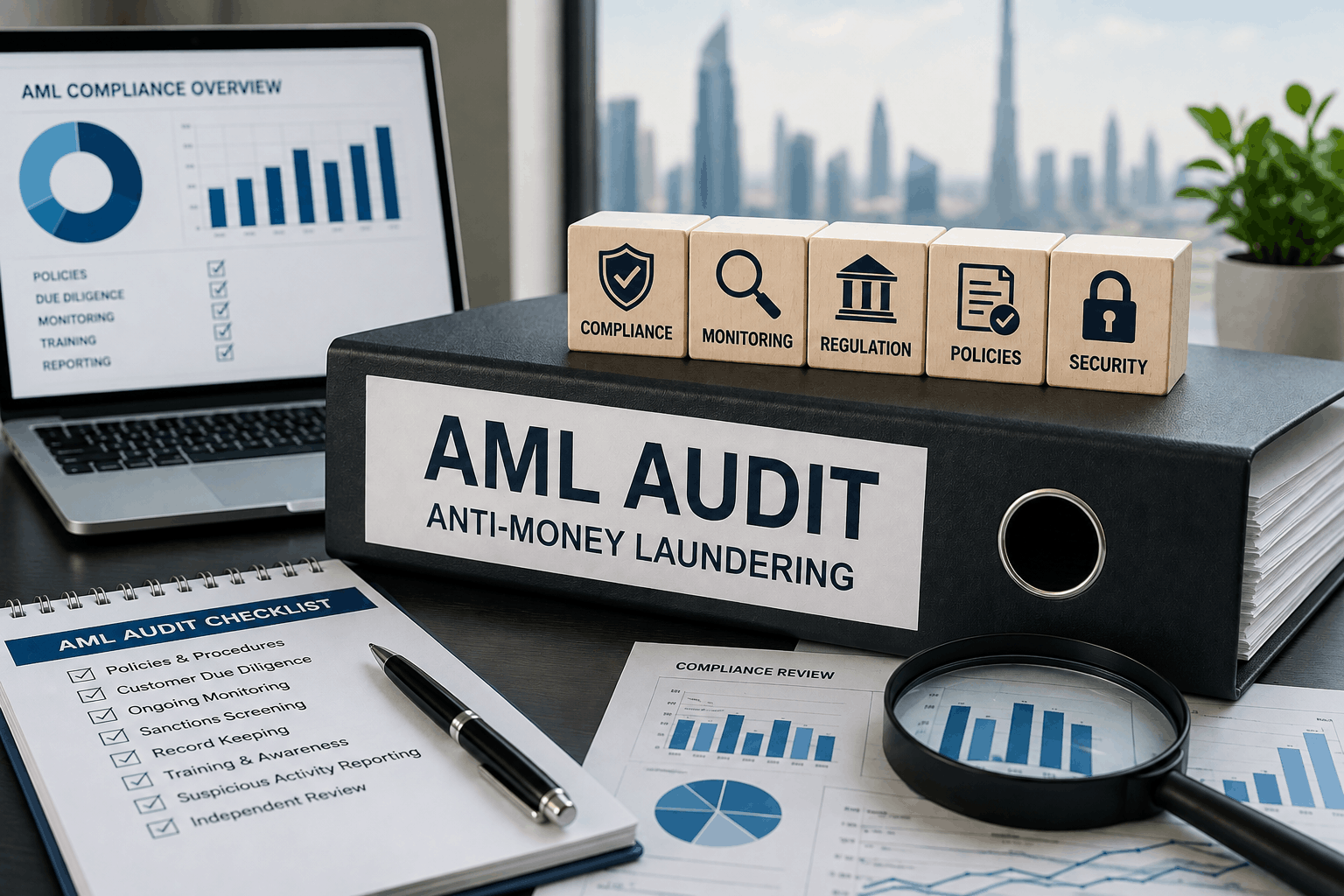
An AML Audit is an independent review of an organization’s AML/CFT policies, procedures, systems, controls, and actual compliance practices.
The purpose is to assess whether the company’s AML framework is appropriately designed and effectively implemented in accordance with applicable UAE regulatory requirements.
An AML Audit may examine areas such as:
- AML/CFT policies and procedures
- Enterprise-Wide Risk Assessment (EWRA)
- Customer Due Diligence (CDD)
- Enhanced Due Diligence (EDD)
- Customer risk classification
- Beneficial ownership identification
- Sanctions and PEP screening
- Ongoing monitoring and Re-KYC
- Suspicious transaction reporting procedures
- Record keeping
- Employee AML/CFT training
- MLRO responsibilities and governance
- Internal compliance controls
The audit provides management with an objective view of whether the organization’s compliance framework is operating effectively.
🏢 Which Businesses Should Consider an AML Audit?
AML Audits are particularly relevant to businesses and professions subject to UAE AML/CFT requirements, including:
- Financial institutions
- Exchange houses
- Dealers in Precious Metals and Stones (DPMS)
- Real estate brokers and agents
- Auditors and accountants
- Trust and company service providers
- Other Designated Non-Financial Businesses and Professions (DNFBPs)
The scope and frequency of an AML Audit should take into account the nature, size, complexity, regulatory obligations, and risk exposure of the business.
📊 Why Is an AML Audit Important?
1. Evaluates Regulatory Compliance
An AML Audit helps assess whether the business’s compliance framework is aligned with the requirements of:
- Federal Decree-Law No. 10 of 2025
- Cabinet Resolution No. 134 of 2025
- Applicable guidance and requirements issued by the relevant supervisory authority
The current framework covers anti-money laundering as well as combating terrorist financing and proliferation financing.
A structured review can highlight areas requiring attention before they become regulatory concerns.
2. Identifies Gaps Between Policy and Practice
A company may have comprehensive AML policies on paper but still experience weaknesses in day-to-day implementation.
An AML Audit can identify issues such as:
- Incomplete customer files
- Inconsistent customer risk ratings
- Missing beneficial ownership information
- Insufficient Enhanced Due Diligence
- Outdated customer information
- Weak ongoing monitoring
- Incomplete screening processes
- Inadequate documentation of compliance decisions
Identifying these gaps enables management to take corrective measures.
3. Assesses the Effectiveness of the Risk-Based Approach
AML compliance in the UAE is fundamentally risk-based.
An AML Audit can assess whether the company’s risk assessment methodology appropriately considers:
- Customer risk
- Geographic risk
- Product and service risk
- Transaction risk
- Delivery channel risk
It can also evaluate whether higher-risk relationships are subject to stronger controls and Enhanced Due Diligence.
4. Reviews Customer Due Diligence and Re-KYC
Customer information can change over time. Ownership structures, business activities, geographical exposure, and risk profiles may all evolve during the course of a business relationship.
An AML Audit reviews whether the business has appropriate processes for:
- Initial KYC
- Beneficial ownership verification
- Risk classification
- Periodic Re-KYC
- Event-driven customer reviews
- Enhanced Due Diligence for higher-risk customers
This helps ensure that customer records remain accurate and relevant.
5. Reviews Screening and Ongoing Monitoring
Effective AML compliance requires businesses to identify potential exposure to sanctions, politically exposed persons (PEPs), and other relevant risk indicators.
An AML Audit may assess whether:
- Screening is performed at appropriate stages
- Potential matches are properly reviewed
- Screening evidence is retained
- Ongoing monitoring is performed where required
- Escalation procedures are clearly documented
The objective is to determine whether screening controls are operating consistently and effectively.
6. Evaluates Suspicious Transaction Reporting Procedures
Businesses subject to AML requirements must have procedures for identifying, escalating, and reporting suspicious activity in accordance with applicable requirements.
An AML Audit can evaluate:
- Internal escalation procedures
- MLRO review processes
- Documentation of suspicious activity assessments
- Reporting procedures
- Record retention
- Staff awareness of red flags
The review can also assess whether employees understand how potential suspicious activity should be escalated internally.
7. Reviews AML/CFT Training
Employees play a critical role in an organization’s AML compliance framework.
An AML Audit may review whether:
- Relevant employees receive AML/CFT training
- Training is appropriate to their roles
- Training records are maintained
- Employees understand common red flags
- Staff understand internal escalation procedures
Regular awareness helps ensure that AML policies are effectively implemented across the organization.
8. Strengthens Governance and MLRO Oversight
The MLRO or Compliance Officer is responsible for overseeing important elements of the company’s AML/CFT framework.
An AML Audit can assess:
- Compliance governance structure
- MLRO authority and independence
- Internal reporting processes
- Management oversight
- Escalation procedures
- Documentation of compliance decisions
Strong governance supports accountability and effective implementation of AML controls.
🔍 Key Areas Typically Covered in an AML Audit
Depending on the business and its regulatory requirements, an AML Audit may cover:
- AML/CFT policies and procedures
- Enterprise-Wide Risk Assessment
- Customer Risk Assessment
- KYC and beneficial ownership
- CDD and EDD
- PEP and sanctions screening
- Ongoing monitoring
- Re-KYC
- Suspicious activity escalation and reporting
- Record keeping
- Employee training
- MLRO governance
- Internal controls
- Regulatory reporting requirements relevant to the sector
The scope should be tailored to the nature and risk profile of the organization rather than applying a one-size-fits-all approach.
🛡️ Preparing for Regulatory Inspections
Supervisory authorities may inspect regulated businesses to assess whether AML/CFT obligations are being implemented effectively.
Conducting an AML Audit before an inspection can help organizations:
- Identify weaknesses early
- Organize compliance documentation
- Review customer files
- Verify risk assessments
- Strengthen internal controls
- Prepare corrective action plans
- Improve overall regulatory readiness
The aim is not merely to prepare documentation for an inspection, but to ensure that the compliance framework is genuinely functioning.
📈 AML Audit vs. AML Gap Analysis
Although closely related, an AML Audit and an AML Gap Analysis are not necessarily identical.
An AML Gap Analysis generally compares the existing compliance framework against applicable requirements to identify missing or inadequate elements.
An AML Audit typically goes further by independently assessing whether existing controls and procedures have actually been implemented and are functioning effectively.
Both can be valuable components of a strong AML/CFT compliance programme.
💼 How Professional AML Auditors Can Help
An independent AML review provides management with a fresh and objective assessment of the organization’s compliance environment.
Professional AML auditors can assist by:
- Reviewing the AML/CFT framework
- Testing implementation of policies and controls
- Reviewing selected customer files and compliance records
- Evaluating EWRA and customer risk methodologies
- Identifying control weaknesses
- Providing practical recommendations
- Preparing structured findings and corrective action points
- Supporting management in strengthening the compliance framework
Independent review can therefore help transform AML compliance from a documentation exercise into an effective risk-management process.
📌 Conclusion
An AML Audit is an important component of an effective AML/CFT compliance framework. It helps businesses evaluate whether their policies, procedures, risk assessments, due diligence measures, monitoring processes, training, and governance arrangements are working as intended.
For regulated UAE businesses, periodic independent reviews can help identify gaps early, improve controls, strengthen regulatory readiness, and support a more effective risk-based approach to financial crime compliance.
At AVS Lewis & Pecker Auditing, our dedicated AML/CFT compliance team provides independent AML Audits, AML Gap Analysis, Enterprise-Wide Risk Assessments, AML/CFT framework implementation, compliance advisory, training, and related support services. We work with businesses across regulated sectors to assess existing controls, identify areas for improvement, and strengthen AML/CFT compliance in line with applicable UAE regulatory requirements.