

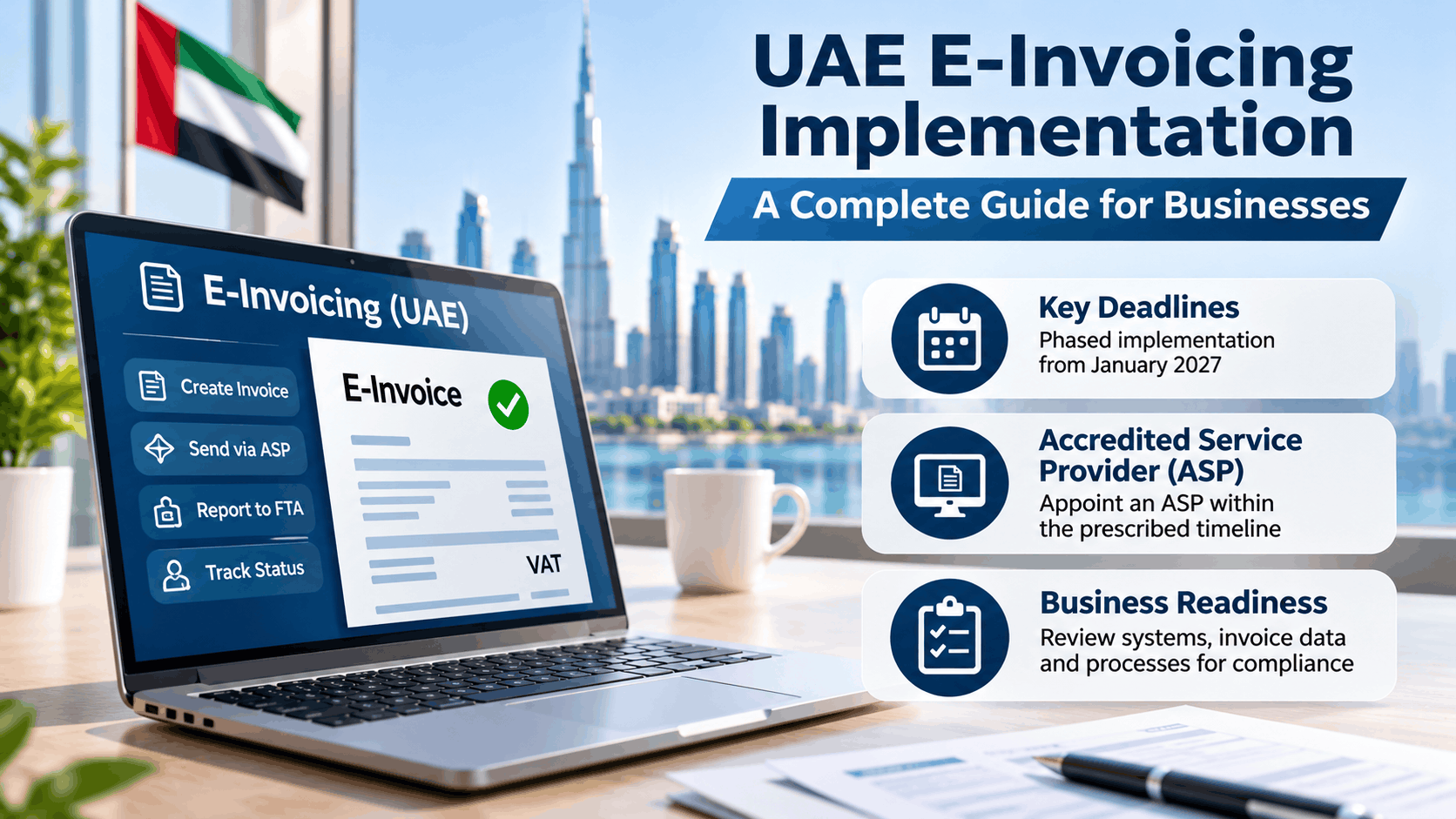
Unlike traditional invoicing, where businesses may issue PDF invoices or exchange documents through email, the UAE’s e-invoicing framework requires qualifying transactions to be processed using structured electronic invoice data through the prescribed system.
With mandatory implementation being introduced in phases, businesses should begin reviewing their accounting systems, invoicing processes and technical readiness.
This guide explains the UAE e-invoicing framework, implementation requirements, timelines and practical steps businesses can take to prepare for compliance.
1. What Is E-Invoicing in the UAE?
Electronic invoicing, commonly referred to as e-invoicing, is the process of issuing, exchanging and processing invoices in a structured electronic format that enables automated interpretation and processing.
Under the UAE’s framework, electronic invoices are exchanged between suppliers and buyers through Accredited Service Providers (ASPs), with relevant tax data reported electronically to the Federal Tax Authority (FTA).
An important distinction is that a PDF invoice sent by email is not considered an electronic invoice under the UAE e-invoicing framework.
Similarly, scanned invoices, Word documents and image files do not qualify merely because they are transmitted electronically.
The UAE framework requires structured invoice data that can be processed by the participating systems in accordance with the applicable technical specifications.
2. Why Is the UAE Introducing E-Invoicing?
The introduction of e-invoicing forms part of the UAE government’s broader digital transformation initiatives.
The system is intended to improve the efficiency, accuracy and transparency of business transactions while supporting tax administration.
Some of the anticipated benefits include:
Improved Invoice Processing
Structured electronic invoices can reduce manual data entry and streamline invoice processing between businesses.
Better Accuracy
Standardised invoice data and automated validations can help reduce certain invoicing errors and inconsistencies.
Enhanced Tax Compliance
Electronic reporting of relevant invoice information can support the FTA’s tax administration and compliance processes.
Reduced Administrative Costs
Businesses may be able to reduce manual document handling, repetitive processing and administrative workloads.
Improved Financial Visibility
Structured invoice information can support reconciliation, reporting and financial analysis.
However, these benefits will depend on the quality of each business’s implementation and its internal processes.
3. Which Businesses Must Comply With UAE E-Invoicing?
The UAE e-invoicing framework generally covers qualifying business transactions involving persons conducting business in the UAE.
The framework is primarily directed at:
- Business-to-Business (B2B) transactions
- Business-to-Government (B2G) transactions
Importantly, the scope is not determined solely by whether a business is registered for VAT.
Businesses should assess their obligations based on the applicable e-invoicing legislation, the nature of their transactions and any specific exclusions.
Are Free Zone Companies Included?
Businesses operating in UAE free zones should not assume that their free zone status automatically exempts them from e-invoicing.
The applicable requirements must be assessed based on the business activities and transactions involved.
Are Small Businesses Included?
The phased implementation framework includes businesses with annual revenue below AED 50 million.
Therefore, smaller businesses should also evaluate their e-invoicing obligations and prepare for the relevant implementation phase.
What About Business-to-Consumer Transactions?
Business-to-Consumer (B2C) transactions are outside the initial mandatory implementation scope under the published framework.
Businesses conducting both B2B and B2C transactions should identify which transactions fall within the applicable e-invoicing requirements.
4. UAE E-Invoicing Implementation Timeline
The UAE has adopted a phased approach to mandatory e-invoicing implementation.
Under Ministerial Decision No. 244 of 2025, as amended, the published implementation milestones include:
| Business Category | Deadline to Appoint an ASP | Mandatory Implementation |
|---|---|---|
| Businesses with annual revenue of AED 50 million or more | 30 October 2026 | 1 January 2027 |
| Businesses with annual revenue below AED 50 million | 31 March 2027 | 1 July 2027 |
| Government entities within scope | 31 March 2027 | 1 October 2027 |
The pilot programme and voluntary implementation commenced on 1 July 2026.
Businesses should review the latest applicable decisions and official guidance to confirm their obligations, including any amendments or transitional arrangements.
Why Should Businesses Begin Preparing Early?
Implementing e-invoicing may require changes to invoice data, accounting processes, software arrangements, internal responsibilities and service-provider relationships.
Leaving these activities until immediately before the mandatory implementation date can create unnecessary operational and compliance risks.
5. How Does the UAE E-Invoicing System Work?
The UAE has adopted a Decentralised Continuous Transaction Control and Exchange (DCTCE) model based on the Peppol framework.
It is commonly described as a five-corner model.
The five corners are:
- Supplier
- Supplier’s Accredited Service Provider
- Buyer’s Accredited Service Provider
- Buyer
- Federal Tax Authority
Step 1: Invoice Data Is Generated
The supplier generates the relevant invoice information through its business or invoicing system.
Step 2: Data Is Submitted to the Supplier’s ASP
The invoice data is transmitted to the supplier’s Accredited Service Provider in an agreed format.
Step 3: Invoice Validation and Conversion
The supplier’s ASP validates the invoice information and, where necessary, converts it into the prescribed structured electronic invoice format.
Step 4: Electronic Invoice Exchange
The supplier’s ASP transmits the electronic invoice to the buyer’s ASP.
Step 5: Delivery to the Buyer
The buyer’s ASP processes and delivers the invoice information to the buyer in accordance with the applicable arrangements.
Step 6: Tax Data Reporting
The relevant Tax Data Document is reported electronically to the FTA through the prescribed framework.
The system also includes technical validation and status messages that support invoice exchange and reporting.
This approach allows businesses to exchange structured invoice information through accredited service providers rather than relying solely on conventional email-based invoicing.
6. What Is an Accredited Service Provider (ASP)?
An Accredited Service Provider is a service provider approved under the UAE’s e-invoicing accreditation framework.
ASPs play an important role in facilitating the exchange of electronic invoices and reporting the required tax information.
Their responsibilities can include:
- Receiving invoice data from businesses
- Validating electronic invoice information
- Converting data into the required format, where applicable
- Facilitating invoice exchange
- Supporting prescribed tax data reporting
- Communicating relevant processing and validation statuses
Businesses within the mandatory scope are required to appoint an ASP in accordance with the applicable framework.
How Should Businesses Choose an ASP?
When evaluating a potential service provider, businesses should consider:
- Accreditation status
- Compatibility with existing business systems
- Technical onboarding requirements
- Data security arrangements
- Pricing structure
- Invoice processing capacity
- Customer support
- Implementation assistance
- Business continuity arrangements
The selection should reflect the company’s transaction volume, operational requirements and existing technology environment.
7. Does Your Business Need to Replace Its Accounting Software?
One of the practical concerns businesses may have is whether their existing accounting or ERP software must be replaced to comply with UAE e-invoicing.
Replacing the entire accounting system is not necessarily required.
The appropriate implementation approach depends on the capabilities of the existing system, the quality of invoice data and the technical arrangements available for exchanging information with the appointed ASP.
Businesses should first evaluate whether their current software can support the required invoice information and workflow.
For some companies, adjustments to their existing system may be sufficient.
Others may require additional software, middleware or a separate invoice-processing solution.
The objective should be to establish a compliant and practical process without introducing unnecessary operational disruption.
8. Step-by-Step Guide to UAE E-Invoicing Implementation
A structured implementation plan can help businesses identify their obligations and prepare their systems before the applicable deadline.
Step 1: Assess Your E-Invoicing Obligations
Begin by reviewing the company’s business activities, revenue and transaction types.
Identify which transactions are within the scope of the UAE e-invoicing framework and whether any exclusions apply.
Step 2: Review Existing Invoice Processes
Understand how invoices are currently generated, approved, issued, received and recorded.
This review should cover both sales invoicing and purchase invoice processing.
Step 3: Evaluate Accounting and ERP Systems
Assess the company’s existing accounting software, ERP platform or other invoicing applications.
Determine whether the systems can capture the required invoice data and support an appropriate electronic invoicing workflow.
Step 4: Review Invoice Data Quality
Check whether the business maintains complete and accurate information relating to:
- Customer details
- Supplier details
- Tax registration information, where applicable
- Invoice numbers and dates
- Product and service descriptions
- Taxable amounts
- VAT treatment
- Currency information
- Credit notes
- Other mandatory invoice fields
Missing or inconsistent data may create difficulties during electronic invoice validation.
Step 5: Select an Accredited Service Provider
Evaluate available ASPs based on the company’s technical, operational and commercial requirements.
Consider implementation support, pricing, transaction volumes and the proposed method of exchanging invoice data.
Step 6: Establish the E-Invoicing Workflow
Determine how invoice information will move from the company’s existing systems to the appointed ASP.
The workflow should also address incoming invoices, processing statuses, errors and rejected transactions.
Step 7: Test the Process
Before implementation, businesses should test relevant scenarios, including:
- Standard sales invoices
- Credit notes
- Different VAT treatments
- Foreign currency invoices
- Invoice corrections
- Rejected or invalid invoices
- Receipt and processing of supplier invoices
Testing can help identify problems before the system becomes part of regular operations.
Step 8: Train Employees
Finance, accounting, sales, procurement and IT personnel should understand their responsibilities under the new process.
Training should cover invoice preparation, validation, exception handling and internal controls.
Step 9: Implement and Monitor
Once the system is ready, the business can begin operating its electronic invoicing process in accordance with its applicable implementation obligations.
Ongoing monitoring is important to identify processing failures, data-quality issues and operational improvements.
Is Your Business Ready for UAE E-Invoicing?
AVS Lewis & Pecker Auditing can assist your business with assessing e-invoicing obligations, reviewing existing processes and preparing for implementation.
Our team can help identify implementation gaps and recommend a practical approach suited to your company’s operations.
9. Common Challenges in UAE E-Invoicing Implementation
Businesses may encounter several challenges during the transition.
Incomplete Invoice Data
Existing invoice templates or customer records may not contain all the information required under the new framework.
Legacy Accounting Systems
Older accounting applications may have limited capabilities for structured invoice data or electronic exchange.
Manual Invoice Processing
Businesses relying heavily on manual invoicing may need to redesign their workflows.
Multiple Business Systems
Companies using separate accounting, inventory, sales and procurement applications may face additional implementation complexity.
Employee Readiness
Staff may require training to understand the new invoicing process and manage exceptions.
ASP Selection
Choosing a service provider without properly evaluating technical compatibility, pricing and operational support can create implementation difficulties.
Inadequate Testing
Insufficient testing may result in invoice rejection, processing delays or reconciliation problems after implementation.
Early assessment can help businesses address these challenges systematically.
10. How Much Does UAE E-Invoicing Implementation Cost?
There is no single implementation cost applicable to every business.
The total cost may depend on factors such as:
- Number of invoices processed
- Existing accounting or ERP software
- Required software changes
- ASP subscription and transaction fees
- Data preparation requirements
- Implementation complexity
- Employee training
- Ongoing technical support
A business using a relatively simple invoicing system may have different implementation requirements from a large organisation operating multiple ERP systems.
Companies should therefore obtain a quotation based on their actual processes and requirements rather than comparing solutions solely on their advertised starting prices.
11. E-Invoicing Compliance: Key Regulatory Considerations
Businesses should understand that e-invoicing involves both technical implementation and regulatory compliance.
Important considerations include:
Electronic Invoice Format
Qualifying invoices must comply with the prescribed structured data requirements.
Accredited Service Provider
Businesses within scope must appoint an ASP in accordance with the applicable requirements.
Invoice Data Accuracy
Electronic invoices must contain the relevant mandatory information.
Electronic Credit Notes
Applicable adjustments, cancellations and corrections may require electronic credit notes under the framework.
Record Retention
Businesses must retain electronic invoices, electronic credit notes and associated data for the applicable statutory retention period and ensure that the records can be provided to the FTA upon request.
Data Security
Businesses should implement appropriate controls to protect invoice information and related business data.
Regulatory Updates
Companies should monitor changes to the e-invoicing legislation, technical specifications and implementation guidance.
For example, amendments introduced in October 2026 provide temporary exclusions for certain transactions between members of the same Tax Group and remove the previous general requirement to store electronic invoice data within the UAE.
Businesses should therefore ensure that their implementation decisions reflect the latest applicable requirements.
12. UAE E-Invoicing Readiness Checklist
Before implementing e-invoicing, businesses should consider the following:
- ✓ Confirm whether the business is within scope.
- ✓ Identify the applicable implementation deadline.
- ✓ Review B2B and B2G transactions.
- ✓ Identify any relevant exclusions.
- ✓ Assess existing invoicing processes.
- ✓ Review accounting and ERP systems.
- ✓ Verify customer and supplier information.
- ✓ Identify missing mandatory invoice data.
- ✓ Evaluate and appoint an appropriate ASP.
- ✓ Establish the invoice exchange process.
- ✓ Define responsibilities for processing errors.
- ✓ Test invoices and credit notes.
- ✓ Train relevant employees.
- ✓ Review data retention and security controls.
- ✓ Establish ongoing monitoring procedures.
Completing these activities before the mandatory implementation date can help reduce disruption and improve compliance readiness.
13. How AVS Lewis & Pecker Auditing Can Assist With UAE E-Invoicing Implementation
AVS Lewis & Pecker Auditing provides professional advisory and compliance services to businesses operating in Dubai and across the UAE.
Our e-invoicing advisory services are intended to help businesses understand their obligations and prepare for the transition to the UAE Electronic Invoicing System.
Depending on the company’s requirements, our assistance may include:
- E-invoicing applicability assessment
- Review of existing invoicing processes
- E-invoicing readiness assessment
- Identification of implementation gaps
- Review of invoice data requirements
- Evaluation of available implementation approaches
- Guidance on ASP selection
- Coordination of implementation activities
- Employee awareness and process guidance
Our approach focuses on helping businesses understand the regulatory requirements and identify practical solutions suited to their existing operations.
14. Introducing AVS EIS – E-Invoicing Solution
Businesses preparing for e-invoicing may also need to consider how their existing accounting processes can support the new requirements.
AVS EIS is an e-invoicing solution developed to support businesses in their transition towards electronic invoicing.
It is intended to provide an additional approach for businesses evaluating their e-invoicing processes and technology requirements.
Businesses should assess the suitability of any proposed solution based on their existing software, invoice volumes, operational needs and the arrangements required with an appointed ASP.
AVS EIS should not be confused with an Accredited Service Provider. The applicable electronic invoice exchange and tax reporting obligations must be fulfilled through the prescribed ASP framework.
Explore AVS EIS – E-Invoicing Solution
Discover AVS EIS, an e-invoicing solution developed to support businesses evaluating their transition to electronic invoicing.
Learn more about AVS EIS and assess whether it is suitable for your company’s existing accounting processes and operational requirements.
Frequently Asked Questions
What is UAE e-invoicing implementation?
UAE e-invoicing implementation involves preparing a business to generate, exchange, receive and process structured electronic invoices in accordance with the applicable UAE Electronic Invoicing System requirements.
Is e-invoicing mandatory for all UAE businesses?
The framework generally covers qualifying business transactions, including B2B and B2G transactions, subject to applicable exclusions. Businesses should assess their obligations based on the nature of their activities and transactions rather than assuming that VAT registration status alone determines applicability.
When does mandatory e-invoicing begin in the UAE?
The published phased implementation framework provides for mandatory implementation beginning on 1 January 2027 for businesses with annual revenue of AED 50 million or more, followed by 1 July 2027 for businesses below that threshold and 1 October 2027 for government entities within scope. Businesses should verify the latest applicable requirements.
Is a PDF invoice considered an electronic invoice?
No. A PDF invoice, scanned document or invoice sent through email does not, by itself, meet the UAE’s structured electronic invoicing requirements.
Does a UAE business need an Accredited Service Provider?
Businesses subject to the mandatory e-invoicing framework are required to appoint an Accredited Service Provider in accordance with the applicable regulations.
Do companies need to replace their existing accounting software?
Not necessarily. The appropriate solution depends on the existing accounting system, the availability of required invoice data and the technical arrangements needed for electronic invoice exchange.
Can free zone companies be subject to UAE e-invoicing?
Yes. Free zone status does not automatically exclude a business from the e-invoicing framework. Applicability depends on the relevant business transactions and regulatory requirements.
What is the difference between an e-invoicing solution and an Accredited Service Provider?
An e-invoicing solution may assist a business with preparing or processing invoice data, while an Accredited Service Provider performs the prescribed electronic invoice exchange and reporting functions under the UAE framework.
How can businesses prepare for e-invoicing?
Businesses can begin by assessing their obligations, reviewing existing invoicing processes, checking invoice data quality, evaluating accounting systems, selecting an appropriate ASP and testing the proposed workflow before implementation.
Conclusion
The introduction of the UAE Electronic Invoicing System represents an important development in the country’s financial and tax administration framework.
For businesses, successful UAE e-invoicing implementation requires more than selecting software. It involves understanding regulatory obligations, reviewing existing accounting processes, ensuring invoice data accuracy and establishing an appropriate workflow with an Accredited Service Provider.
Early preparation can help companies identify implementation challenges, manage costs and reduce operational disruption.
Businesses should therefore begin evaluating their e-invoicing readiness and develop a structured implementation plan based on their specific requirements.
Need Assistance With UAE E-Invoicing Implementation?
AVS Lewis & Pecker Auditing can assist businesses with understanding their e-invoicing requirements and preparing for implementation.
Speak with our team to discuss your company’s current invoicing processes, accounting systems and compliance readiness.
Request an E-Invoicing Consultation
Businesses interested in exploring alternative invoice-processing approaches can also learn more about AVS EIS – E-Invoicing Solution.
Disclaimer
This article is intended for general informational purposes only and does not constitute legal, tax, regulatory, accounting or technical advice. UAE e-invoicing legislation, implementation timelines, technical specifications and regulatory procedures may be amended. Businesses should refer to the latest publications issued by the UAE Ministry of Finance and Federal Tax Authority and obtain professional advice based on their specific circumstances.