

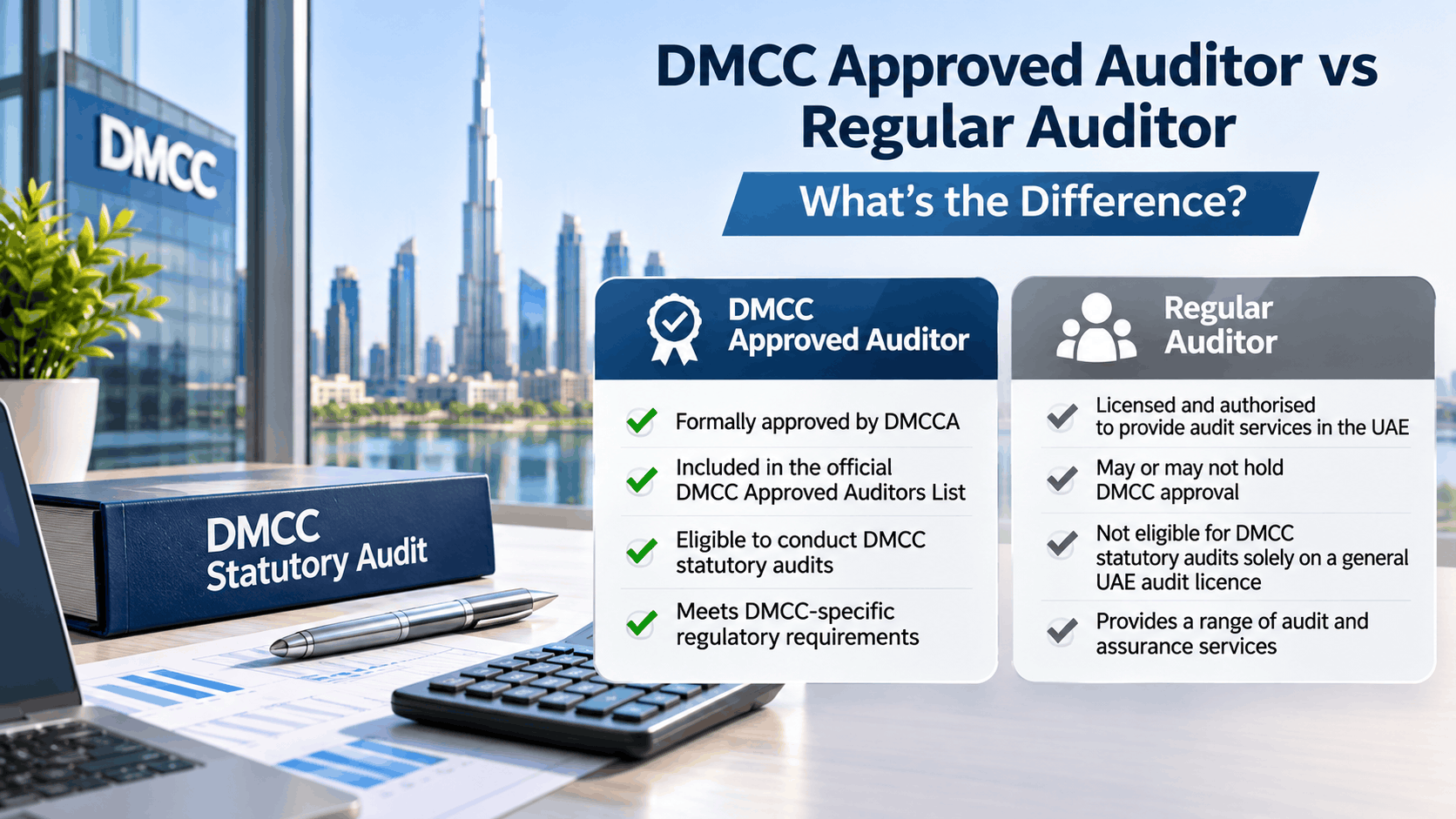
Although many audit firms provide professional Auditing Services in Dubai, not every licensed audit firm is authorised to conduct statutory audits for DMCC member companies.
DMCC maintains an approval framework for audit firms, and companies must appoint an auditor recognised by the DMCC Authority for their statutory audit requirements.
Understanding the difference between a DMCC Approved Auditor and a regular auditor can help businesses make an informed decision, avoid appointment-related compliance issues and complete their annual audit process more efficiently.
This article explains the key differences, DMCC auditor approval requirements and important considerations when selecting an audit firm.
1. What Is a DMCC Approved Auditor?
A DMCC Approved Auditor is an audit firm that has been formally approved by the Dubai Multi Commodities Centre Authority (DMCCA) to audit the annual accounts of DMCC member companies.
To obtain this approval, an audit firm must satisfy the applicable eligibility requirements and complete the DMCC approval process.
The approval framework is governed by the DMCCA Approved Auditor Rules, which establish requirements relating to audit firms, audit partners, professional qualifications, responsibilities and ongoing compliance.
Once approved, the audit firm is included in the official DMCC Approved Auditors List.
Why Is DMCC Approval Important?
DMCC companies are subject to specific regulatory requirements concerning the appointment of auditors and the preparation and submission of audited financial statements.
The appointment of a DMCC Approved Auditor helps ensure that the statutory audit is conducted by a firm authorised under the DMCC regulatory framework.
This approval is therefore an important eligibility requirement rather than simply an additional professional certification.
2. What Is a Regular Auditor in Dubai?
A regular auditor, in the context of this comparison, refers to an audit firm that is appropriately licensed and authorised to provide audit services in the UAE but does not necessarily hold DMCC approval.
Such firms may provide a range of professional services, including:
- Statutory financial statement audits
- Internal audits
- Financial reporting reviews
- Compliance audits
- Internal control assessments
- Other assurance and advisory engagements
However, being licensed to provide auditing services in the UAE does not automatically mean that an audit firm is approved to conduct statutory audits for DMCC member companies.
Does This Mean Regular Auditors Are Less Qualified?
Not necessarily.
A licensed audit firm may possess extensive professional experience, qualified audit personnel and strong technical capabilities without being registered as a DMCC Approved Auditor.
The principal difference is the firm’s specific authorisation to perform statutory audits under the DMCC framework.
Therefore, businesses should distinguish between general professional audit qualifications and approval by a particular regulatory authority.
3. DMCC Approved Auditor vs Regular Auditor: Key Differences
The following comparison highlights the principal differences.
| Criteria | DMCC Approved Auditor | Regular Auditor |
|---|---|---|
| UAE audit licence | Must satisfy applicable UAE licensing requirements | Must hold the applicable authorisation for the audit services offered |
| DMCC approval | Specifically approved by DMCCA | May or may not hold DMCC approval |
| Official DMCC listing | Included in the DMCC Approved Auditors List | Not listed unless separately approved |
| DMCC statutory audit | Eligible to perform, subject to continuing approval and applicable requirements | Not eligible solely on the basis of a general UAE audit licence |
| Regulatory framework | Subject to applicable UAE requirements and DMCC Approved Auditor Rules | Subject to applicable UAE professional and regulatory requirements |
| Audit standards | Must comply with applicable professional auditing requirements | Must comply with applicable professional auditing requirements |
| DMCC-specific obligations | Must meet relevant DMCC requirements | No DMCC-approved status unless approval is obtained |
| Suitability for DMCC companies | Meets the specific DMCC auditor-approval requirement | Approval must be verified before appointment |
The most important distinction is that DMCC approval is an additional authorisation required for conducting statutory audits of DMCC member companies.
It does not mean that the fundamental auditing standards are different or that non-approved firms are inherently less competent.
4. Why Does DMCC Require Approved Auditors?
DMCC has established its Approved Auditor framework to support the quality and reliability of financial reporting by member companies.
Under the DMCCA Approved Auditor Rules, the framework is intended to strengthen audit quality, support reliable audited financial statements and improve the identification of relevant non-compliance concerns.
Maintaining Financial Reporting Quality
DMCC requires member companies to prepare financial statements in accordance with applicable financial reporting requirements.
Approved auditors examine these financial statements and report their findings in accordance with the relevant auditing standards.
Strengthening Regulatory Oversight
The approval framework allows DMCCA to establish eligibility requirements and monitor audit firms that undertake statutory audits of member companies.
Supporting Financial Transparency
Audited financial statements provide shareholders and other relevant stakeholders with information about a company’s financial position and performance.
Identifying Potential Compliance Concerns
The Approved Auditor Rules also address responsibilities relating to suspected fraud, money laundering and other non-compliance.
These requirements reinforce the importance of professional judgement, audit quality and appropriate reporting procedures.
5. What Are the Requirements to Become a DMCC Approved Auditor?
An audit firm seeking DMCC approval must complete the prescribed application process and satisfy the relevant eligibility criteria.
The requirements may include:
Valid Professional Authorisation
The audit firm must hold the relevant commercial or professional licence and satisfy applicable UAE audit authorisation requirements.
Qualified Audit Partner
The audit partner must possess the professional authorisation required to report on company accounts.
Application and Supporting Documentation
The firm must submit the required application information and supporting documents through the prescribed DMCC process.
Compliance With DMCC Approval Criteria
DMCCA evaluates applications in accordance with its Approved Auditor Rules and associated guidance.
Ongoing Approval Requirements
Approved firms must comply with applicable continuing obligations, including renewal requirements and any relevant monitoring or review procedures.
Businesses should note that DMCC approval is not automatically granted to every audit firm operating in Dubai.
6. Can a DMCC Company Appoint a Regular Auditor?
For its statutory audit under the DMCC Company Regulations, a DMCC member company must appoint an auditor approved by DMCCA.
A general UAE audit licence alone is not sufficient to establish eligibility.
What If the Company Already Has an Auditor?
A company may already engage an audit firm for financial reporting, internal audit, tax advisory or other professional services.
However, before appointing that firm for its DMCC statutory audit, the company should verify that the firm holds the required DMCC approval.
Can a Non-DMCC-Approved Auditor Provide Other Services?
A firm that does not hold DMCC approval may still be able to provide other professional services to a DMCC company, subject to the applicable licensing, professional and independence requirements.
These services may include accounting support, internal audit, tax advisory or financial reporting assistance.
However, such engagements should not be confused with the statutory audit appointment required under the DMCC Company Regulations.
7. How Can Businesses Verify Whether an Auditor Is DMCC Approved?
Before appointing an audit firm, businesses should verify its approval status.
Step 1: Check the Official DMCC Approved Auditors List
DMCC maintains an official list of approved audit firms through its website.
Companies can refer to this list to confirm whether their proposed auditor is recognised by DMCCA.
Step 2: Confirm the Audit Firm’s Legal Name
The name appearing on the official list should correspond to the audit firm being appointed.
This is particularly important where firms operate under similar trading names or have different legal entities.
Step 3: Confirm Current Approval Status
Companies should verify that the approval remains valid at the time of appointment.
Step 4: Review the Firm’s Experience
In addition to confirming approval, businesses should evaluate the firm’s professional experience, industry knowledge and audit capabilities.
The official DMCC Approved Auditors List is available through the
DMCC Compliance and Regulations Knowledge Bank
.
Looking for a DMCC Approved Auditor in Dubai?
AVS Lewis & Pecker Auditing is a DMCC Approved Auditor providing statutory audit services to businesses operating in the DMCC Free Zone.
Our team can assist your company with understanding the audit requirements, preparing the necessary documentation and planning the statutory audit process.
8. Do DMCC Approved Auditors Follow Different Auditing Standards?
A common misconception is that DMCC Approved Auditors perform audits using an entirely different set of auditing standards.
This is not the case.
Both DMCC Approved Auditors and other appropriately authorised audit firms are expected to comply with the professional standards applicable to their engagements.
For DMCC statutory audits, the relevant framework includes:
- Applicable International Standards on Auditing (ISA)
- International Financial Reporting Standards (IFRS), as applicable to the financial statements
- UAE professional and regulatory requirements
- DMCC Company Regulations
- DMCCA Approved Auditor Rules
What Makes a DMCC Audit Different?
The distinction primarily relates to the regulatory framework governing the company and the auditor’s eligibility.
DMCC companies must satisfy specific requirements concerning auditor appointment, financial statement preparation, approval and filing.
A DMCC Approved Auditor must therefore understand these requirements in addition to performing the financial statement audit.
9. What Happens If a DMCC Company Appoints a Non-Approved Auditor?
Appointing an auditor who does not hold the required DMCC approval may create compliance difficulties.
Potential consequences include:
Problems With Statutory Audit Compliance
An audit conducted by a non-approved firm may not satisfy the specific auditor-appointment requirements under the DMCC framework.
Delays in Financial Statement Submission
If the company needs to appoint an eligible auditor and arrange additional audit procedures, the financial reporting process may be delayed.
Additional Professional Costs
The company may incur additional costs if further audit work is required.
Potential Regulatory Consequences
Failure to meet applicable DMCC audit and filing requirements may expose the company to regulatory consequences, depending on the circumstances.
Businesses should therefore confirm the auditor’s eligibility before finalising the appointment rather than discovering an issue after the audit has been completed.
10. Is a DMCC Approved Auditor More Expensive Than a Regular Auditor?
Not necessarily.
The cost of an audit depends on several factors, including:
- Size of the company
- Nature of business activities
- Annual turnover
- Transaction volume
- Quality of accounting records
- Complexity of financial reporting
- Number of subsidiaries or related entities
- Inventory and asset verification requirements
- Audit scope and reporting requirements
DMCC approval does not automatically mean that an audit firm will charge higher fees.
Similarly, a lower audit fee does not necessarily indicate better value.
Businesses should evaluate the proposed audit scope, the firm’s experience, reporting timelines and professional capabilities before making a decision.
11. How to Choose the Right DMCC Approved Auditor in Dubai
While DMCC approval is essential, it should not be the only consideration when selecting an auditor.
Verify DMCC Approval
Confirm that the firm appears on the official DMCC Approved Auditors List.
Evaluate Industry Experience
Choose a firm familiar with your business activities.
For example, businesses involved in commodity trading, gold, precious metals, jewellery or international trade may have specific accounting and audit considerations.
Review Technical Expertise
The audit team should possess appropriate knowledge of IFRS, auditing standards and relevant regulatory requirements.
Consider Communication and Availability
An audit firm should provide clear information about the audit process, documentation requirements and expected timelines.
Understand the Audit Scope
Before appointing the auditor, obtain clarity regarding the scope of work, responsibilities, reporting deliverables and professional fees.
Assess Audit Planning
A well-planned audit can help businesses identify documentation requirements early and reduce avoidable delays.
Consider Professional Independence
Where an audit firm also offers accounting, tax or advisory services, the company and auditor should consider the applicable independence requirements before accepting additional engagements.
Selecting the right firm involves balancing regulatory eligibility, technical expertise, industry knowledge and professional service quality.
12. Documents Commonly Required for a DMCC Statutory Audit
A DMCC Approved Auditor will generally request relevant financial and supporting information to conduct the audit.
Depending on the nature of the business, this may include:
- Trial balance and general ledger
- Financial statements
- Bank statements and reconciliations
- Sales and purchase records
- Customer and supplier balances
- Inventory records
- Fixed asset register
- Loan and financing agreements
- Related-party transaction details
- Corporate Tax and VAT records, where relevant
- Supporting contracts and agreements
- Previous year’s audited financial statements
- Other documents relevant to the audit
The exact documentation requirements will depend on the company’s activities, financial reporting complexity and audit findings.
Preparing these records in advance can help improve audit efficiency.
13. How AVS Lewis & Pecker Auditing Can Assist DMCC Companies
AVS Lewis & Pecker Auditing is a DMCC Approved Auditor providing statutory audit and related professional services to businesses operating in Dubai and across the UAE.
Our team has experience working with businesses across different industries, including:
- Gold and precious metals
- Jewellery
- Commodity trading
- General trading
- Professional services
- Other commercial activities
Our statutory audit services focus on examining financial statements in accordance with applicable professional standards and regulatory requirements.
We assist DMCC companies with understanding the statutory audit process, identifying documentation requirements and coordinating the audit engagement.
Our broader professional services also include internal audit, taxation, AML/CFT advisory and other business compliance services, subject to applicable professional independence requirements.
Businesses looking for DMCC Approved Auditing Services can contact our team to discuss their audit requirements and obtain a professional quotation.
Frequently Asked Questions
What is the difference between a DMCC Approved Auditor and a regular auditor?
A DMCC Approved Auditor is an audit firm specifically approved by DMCCA to conduct statutory audits of DMCC member companies. A regular licensed auditor may provide audit services in the UAE but cannot undertake a DMCC statutory audit solely on the basis of its general audit licence.
Is it mandatory to appoint a DMCC Approved Auditor?
Yes. DMCC member companies subject to the statutory audit requirements must appoint an auditor approved by DMCCA, in accordance with the applicable Company Regulations.
Can any audit firm in Dubai audit a DMCC company?
No. A firm must hold the required DMCC approval to conduct the statutory audit of a DMCC member company. General authorisation to provide Auditing Services in Dubai does not automatically confer DMCC approval.
How can I check whether an auditor is approved by DMCC?
Businesses can refer to the official DMCC Approved Auditors List published through the DMCC website and verify the proposed audit firm’s current approval status.
Are DMCC Approved Auditors required to follow IFRS?
DMCC companies must prepare financial statements in accordance with applicable financial reporting requirements, including IFRS where required. Approved auditors examine those financial statements under the relevant auditing framework.
Can a regular auditor provide internal audit services to a DMCC company?
A suitably authorised firm may provide internal audit or other professional services to a DMCC company, subject to applicable licensing, independence and regulatory requirements. Such services do not replace the statutory audit performed by a DMCC Approved Auditor.
Is a DMCC Approved Auditor more expensive?
Not necessarily. Audit fees depend on the company’s size, activities, transaction volume, financial reporting complexity and the scope of audit work required.
Can a DMCC company change its approved auditor?
Yes. A DMCC company may change its auditor by following the applicable appointment and change procedures, including any required filings or approvals.
What should I consider when choosing a DMCC Approved Auditor?
Businesses should evaluate DMCC approval status, industry experience, technical competence, professional independence, audit approach, communication, reporting timelines and fees.
Conclusion
Understanding the difference between a DMCC Approved Auditor and a regular auditor is important for companies operating in the DMCC Free Zone.
While both may possess the professional qualifications and experience required to perform financial statement audits, DMCC approval is a specific regulatory authorisation necessary for conducting statutory audits of DMCC member companies.
Businesses should therefore verify an audit firm’s approval status before appointment.
Beyond regulatory eligibility, companies should also consider the auditor’s industry experience, technical capabilities, professional approach and ability to manage the engagement effectively.
Selecting a suitable DMCC Approved Auditor can help businesses meet their statutory audit obligations while maintaining reliable financial reporting practices.
Need Assistance With Your DMCC Statutory Audit?
AVS Lewis & Pecker Auditing provides DMCC statutory audit services to businesses across different sectors.
Whether your company is preparing for its annual statutory audit or considering appointing a new auditor, our team can assist you in understanding the requirements and planning the engagement.
Disclaimer
This article is intended for general informational purposes only and does not constitute legal, accounting, auditing or regulatory advice. DMCC regulations, auditor approval requirements and related procedures may change. Businesses should refer to the latest publications issued by DMCCA and obtain professional advice based on their specific circumstances.