

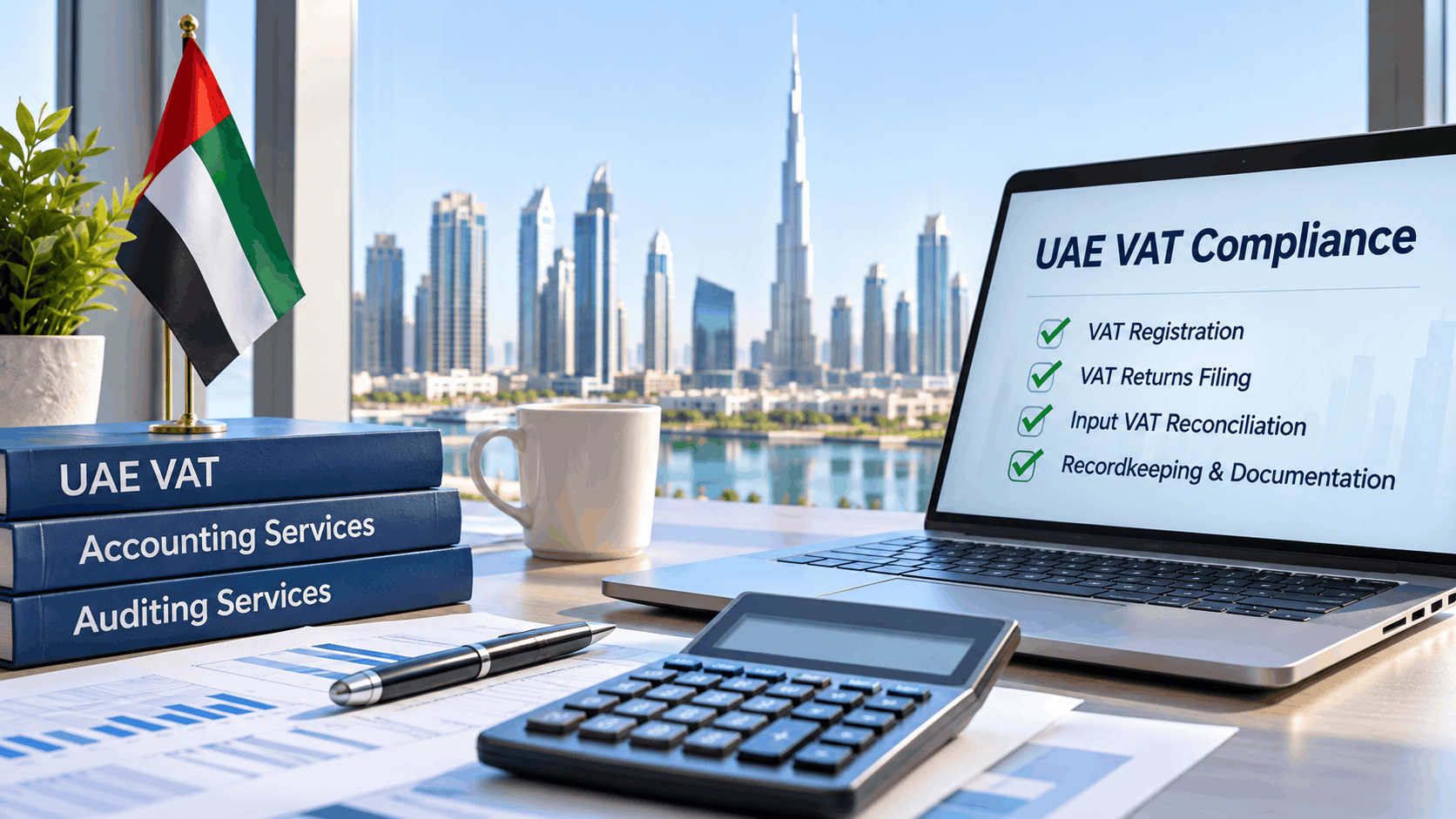
Although the UAE operates a standard VAT rate of 5%, managing VAT compliance involves more than simply calculating tax on sales and purchases.
Businesses must consider VAT registration requirements, transaction classifications, input tax recovery, recordkeeping, reconciliations and periodic reporting.
For companies managing large transaction volumes or complex business activities, these responsibilities can become challenging without an organised accounting system.
This is where professional Accounting Services in UAE can play an important role.
By maintaining accurate financial records, reviewing transactions and supporting VAT reporting, accounting professionals can help businesses simplify their compliance processes and reduce the risk of avoidable errors.
This article explains the key aspects of VAT Compliance in UAE and how professional accounting services can support businesses in meeting their obligations.
1. Understanding VAT Compliance in UAE
VAT is an indirect tax imposed on the supply of goods and services, subject to the applicable provisions of UAE VAT legislation.
The standard VAT rate in the UAE is 5%, although certain supplies may qualify for zero-rating or exemption.
Businesses registered for VAT are generally required to account for VAT on taxable supplies and may recover eligible input VAT incurred on business expenses, subject to the relevant conditions.
VAT compliance involves several responsibilities, including:
- Monitoring VAT registration requirements
- Applying the appropriate VAT treatment to transactions
- Issuing compliant tax invoices and credit notes
- Maintaining accurate financial records
- Reviewing input VAT recovery eligibility
- Preparing and submitting VAT returns
- Paying VAT liabilities within the prescribed deadlines
- Retaining supporting documents
- Responding to Federal Tax Authority (FTA) enquiries, where applicable
Effective VAT compliance requires businesses to establish appropriate accounting processes and internal controls.
2. VAT Registration Requirements for UAE Businesses
Understanding whether a business is required to register for VAT is one of the first steps in maintaining compliance.
Under the applicable UAE VAT framework, the principal registration thresholds for UAE-resident businesses are:
| Registration Type | Threshold |
|---|---|
| Mandatory VAT Registration | AED 375,000 |
| Voluntary VAT Registration | AED 187,500 |
Mandatory registration generally applies when the value of taxable supplies and imports exceeds the prescribed threshold over the previous 12 months or is expected to exceed it within the next 30 days.
Voluntary registration may be available where the relevant taxable supplies, imports or qualifying taxable expenses exceed the voluntary registration threshold.
Different registration considerations may apply to non-resident businesses.
How Accounting Services Help
Professional accountants can assist businesses by:
- Monitoring taxable turnover
- Reviewing VAT registration eligibility
- Identifying transactions relevant to registration thresholds
- Preparing supporting financial information
- Assisting with VAT registration applications
- Monitoring changes in business activities that may affect registration obligations
Regular monitoring is particularly important for growing businesses approaching the mandatory VAT registration threshold.
3. Maintaining Accurate Accounting Records for VAT Compliance
Accurate accounting records form the foundation of effective VAT compliance.
Businesses need reliable financial information to calculate output VAT, determine recoverable input VAT and prepare periodic VAT returns.
Incomplete or inconsistent accounting records can result in incorrect VAT reporting and difficulties during regulatory reviews.
Important Accounting Records
Businesses should maintain appropriate documentation, including:
- Sales invoices
- Purchase invoices
- Tax credit notes
- Bank statements
- Customer and supplier ledgers
- Import and export documentation
- Expense records
- General ledger
- VAT control accounts
- Supporting contracts and agreements
- Records of relevant adjustments
How Accounting Services Simplify Recordkeeping
Professional Accounting Services in UAE can help businesses establish organised bookkeeping and financial reporting procedures.
This may include maintaining ledgers, recording transactions, reconciling balances and reviewing supporting documents.
Proper accounting records allow businesses to identify discrepancies early and prepare more reliable VAT returns.
4. Ensuring Correct VAT Treatment of Transactions
Not every transaction is subject to the same VAT treatment.
Depending on the nature of the supply and the applicable legislation, transactions may be:
- Standard-rated
- Zero-rated
- Exempt
- Outside the scope of UAE VAT
- Subject to reverse charge provisions
Incorrect classification can affect VAT calculations, input tax recovery and the information reported in VAT returns.
For example, businesses engaged in international trading, real estate, financial services or cross-border transactions may encounter VAT treatments that require additional consideration.
Role of Accounting Professionals
Accounting and tax professionals can assist by reviewing the nature of transactions and identifying matters requiring further VAT analysis.
This can help businesses apply the appropriate tax treatment and reduce the risk of incorrectly reporting taxable supplies.
5. Preparing and Filing Accurate VAT Returns
VAT-registered businesses must submit VAT returns according to their assigned tax periods.
VAT returns generally include information relating to:
- Taxable sales and output VAT
- Zero-rated supplies
- Exempt supplies, where applicable
- Eligible purchases and input VAT
- Adjustments
- Net VAT payable or recoverable
Under the general FTA requirements, VAT returns and related payments must be completed within 28 days following the end of the relevant tax period, subject to applicable rules.
How Accounting Services Support VAT Return Filing
Professional accountants can assist businesses with:
- Reviewing sales and purchase transactions
- Reconciling VAT control accounts
- Identifying missing or incorrect entries
- Reviewing input VAT eligibility
- Preparing VAT return workings
- Comparing VAT returns with accounting records
- Assisting with submission through EmaraTax
- Maintaining supporting schedules for future reference
A structured review process can improve reporting accuracy and reduce the likelihood of errors.
6. Input VAT Recovery: Avoiding Common Mistakes
Input VAT recovery is an important area of VAT compliance.
VAT-registered businesses may generally recover eligible VAT incurred on purchases and expenses used for making taxable supplies, subject to the applicable legal requirements.
However, not all VAT incurred by a business is recoverable.
Certain expenses may be restricted, while businesses making both taxable and exempt supplies may need to consider input tax apportionment.
Common issues include:
- Claiming VAT without adequate supporting documents
- Recovering VAT on restricted expenses
- Incorrectly treating personal expenses as business expenses
- Failing to consider input tax apportionment
- Recording purchase invoices in the wrong reporting period
- Applying incorrect VAT treatment to imports or reverse charge transactions
How Accounting Services Help
Accounting professionals can review purchase records, supporting tax invoices and VAT classifications to identify potential recovery issues.
This can help businesses support eligible claims and avoid inappropriate input VAT deductions.
7. VAT Reconciliation: An Important Compliance Control
VAT reconciliation involves comparing VAT-related accounting balances with the amounts reported in VAT returns.
It helps identify differences between the company’s financial records and its tax reporting.
Common VAT Reconciliations
- Sales ledger versus VAT return sales figures
- Purchase ledger versus input VAT claimed
- Output VAT account versus VAT returns
- Input VAT account versus VAT returns
- VAT payable or receivable versus FTA account balances
- Credit notes and adjustments
- Import VAT records
Why Regular Reconciliation Matters
Without regular reconciliations, errors may accumulate across multiple tax periods.
Professional accounting support can help businesses establish monthly or quarterly reconciliation procedures.
This improves the reliability of VAT reporting and allows discrepancies to be investigated before returns are submitted.
8. Common VAT Compliance Challenges Faced by UAE Businesses
Despite the established VAT framework, businesses may continue to encounter practical compliance challenges.
Incorrect Tax Invoices
Invoices may contain missing or inaccurate information, including tax registration details, invoice dates or VAT amounts.
Incomplete Accounting Records
Missing invoices, unreconciled transactions and inaccurate bookkeeping can affect VAT reporting.
Incorrect VAT Classification
Transactions may be incorrectly classified as standard-rated, zero-rated, exempt or outside the scope of VAT.
Errors in Input VAT Recovery
Businesses may claim VAT on expenses that do not satisfy the relevant recovery conditions.
Late VAT Return Filing
Failure to monitor reporting deadlines may result in late submissions and potential administrative penalties.
Unreconciled VAT Balances
Differences between accounting records and submitted VAT returns may remain unresolved.
Changes in VAT Regulations
Businesses may fail to update their accounting processes following legislative amendments or changes in FTA guidance.
Professional accounting and VAT advisory support can help businesses address these challenges through regular reviews and organised reporting procedures.
9. How Professional Accounting Services Simplify VAT Compliance
Professional Accounting Services in UAE can support VAT compliance at different stages of the accounting cycle.
Day-to-Day Bookkeeping
Recording transactions accurately helps maintain reliable information for VAT reporting.
Monthly Accounting Reviews
Periodic reviews can identify missing invoices, incorrect classifications and reconciliation differences.
VAT Return Preparation
Accounting professionals can assist with preparing VAT workings and reviewing supporting information.
VAT Reconciliations
Regular reconciliations help ensure consistency between accounting records and submitted VAT returns.
Compliance Monitoring
Professional support can help businesses monitor relevant reporting deadlines and regulatory developments.
Management Reporting
Reliable financial records provide management with better visibility over tax liabilities and cash-flow requirements.
By combining these activities, businesses can develop a more structured and manageable VAT compliance process.
Need Professional Accounting Services in UAE?
AVS Lewis & Pecker Auditing provides accounting, bookkeeping and VAT compliance support to businesses across Dubai and the UAE.
Our team can assist with maintaining accurate financial records, VAT reconciliations and preparing the information required for periodic VAT reporting.
10. The Importance of VAT Compliance Reviews and Auditing Services
In addition to routine accounting, periodic VAT compliance reviews can help businesses evaluate whether their existing procedures are operating effectively.
Such reviews may cover:
- VAT registration status
- Transaction classifications
- Tax invoice compliance
- Input VAT recovery
- VAT return reconciliations
- Supporting documentation
- Internal controls
- Reporting procedures
- Potential areas of non-compliance
Businesses seeking Auditing Services in Dubai may also benefit from independent assessments of relevant accounting controls and compliance processes.
However, a statutory financial statement audit and a VAT compliance review serve different purposes.
A statutory audit provides an opinion on financial statements in accordance with the applicable auditing framework, whereas a VAT compliance review focuses on the business’s adherence to relevant VAT requirements.
The appropriate service should therefore be selected based on the company’s objectives and compliance needs.
11. VAT Compliance in Dubai: Considerations for Growing Businesses
As businesses expand, VAT compliance may become more complex.
Companies with multiple branches, large transaction volumes, international operations or different revenue streams may need more detailed accounting and VAT review procedures.
Common considerations include:
- Multiple business activities
- Imports and exports
- Cross-border services
- Related-party transactions
- Intercompany arrangements
- Different VAT treatments
- High-volume invoicing
- Multiple accounting systems
- Complex expense allocations
For businesses seeking support with VAT Compliance in Dubai, professional accounting services can help establish processes suited to the size and complexity of their operations.
Regular reviews become particularly important as transaction volumes increase.
12. VAT Compliance and the Transition to UAE E-Invoicing
The UAE’s introduction of electronic invoicing represents another important development in business financial reporting.
Although VAT compliance and e-invoicing are distinct requirements, they are closely connected through invoice accuracy, transaction data and accounting processes.
Businesses preparing for e-invoicing should review whether their existing systems maintain accurate information relating to:
- Customer and supplier details
- Tax registration numbers
- Invoice dates and references
- Taxable values
- VAT rates and amounts
- Credit notes
- Transaction classifications
Maintaining accurate accounting records can help businesses prepare for the transition to structured electronic invoicing.
Companies should assess their e-invoicing obligations separately and review the applicable implementation requirements.
To learn more about the UAE’s electronic invoicing framework, visit our
E-Invoicing Services
page.
13. VAT Compliance Checklist for UAE Businesses
Businesses can use the following checklist to evaluate their VAT compliance readiness:
- ✓ Confirm VAT registration status
- ✓ Monitor taxable turnover against registration thresholds
- ✓ Maintain accurate accounting records
- ✓ Issue compliant tax invoices and credit notes
- ✓ Review VAT treatment of transactions
- ✓ Verify input VAT recovery eligibility
- ✓ Reconcile sales and purchase records
- ✓ Reconcile VAT control accounts
- ✓ Review import and export transactions
- ✓ Prepare VAT returns using accurate financial information
- ✓ Submit VAT returns within the prescribed deadlines
- ✓ Pay VAT liabilities on time
- ✓ Retain supporting records for the applicable period
- ✓ Monitor relevant changes in VAT legislation
- ✓ Conduct periodic VAT compliance reviews
A structured checklist can help businesses identify potential gaps and strengthen their internal compliance processes.
14. How AVS Lewis & Pecker Auditing Can Assist
AVS Lewis & Pecker Auditing provides professional accounting, taxation, audit and advisory services to businesses operating in Dubai and across the UAE.
Our team assists businesses with maintaining organised accounting records and addressing their VAT compliance requirements.
Our services include:
- Accounting and bookkeeping services
- VAT registration assistance
- VAT return preparation and filing support
- VAT reconciliation
- VAT compliance reviews
- VAT advisory services
- Review of accounting records
- Financial reporting assistance
- Internal audit and assurance services
- Accounting process improvement
We work with businesses across different sectors, including trading, gold and precious metals, jewellery, real estate and professional services.
Our approach focuses on helping businesses maintain accurate financial records, understand their compliance obligations and establish practical accounting procedures.
Frequently Asked Questions
What is VAT Compliance in UAE?
VAT compliance involves meeting the requirements of UAE VAT legislation, including registration where applicable, issuing appropriate tax invoices, maintaining records, applying correct VAT treatments, submitting returns and paying VAT liabilities within the prescribed deadlines.
How can accounting services help with VAT compliance?
Professional accounting services can help businesses maintain accurate transaction records, reconcile VAT balances, prepare VAT return workings, review supporting documentation and identify potential reporting errors.
Is VAT registration mandatory for every UAE business?
No. VAT registration depends on the applicable registration rules. For UAE-resident businesses, mandatory registration generally applies when taxable supplies and imports exceed AED 375,000 over the relevant period or are expected to exceed that threshold within the next 30 days. Different rules may apply to non-resident businesses.
How often must businesses submit VAT returns in the UAE?
VAT returns must be submitted according to the tax periods assigned by the FTA. Businesses commonly have monthly or quarterly tax periods, and returns are generally due within 28 days after the end of the relevant period.
Can accounting services help prevent VAT penalties?
Professional accounting services can help reduce the risk of compliance errors through accurate bookkeeping, reconciliations, timely reporting and regular reviews. However, engaging an accountant does not eliminate the business’s legal responsibilities or guarantee that penalties will not arise.
What is the difference between VAT accounting and a VAT compliance review?
VAT accounting involves recording transactions and preparing information used for VAT reporting. A VAT compliance review evaluates whether the business’s VAT treatment, documentation, reporting and procedures are consistent with applicable requirements.
Do free zone companies need to comply with UAE VAT?
Free zone companies are not automatically exempt from UAE VAT. The VAT treatment depends on the nature of their activities, transactions and the relevant provisions of UAE VAT legislation, including special rules that may apply to Designated Zones.
Why is regular VAT reconciliation important?
VAT reconciliation helps identify differences between accounting records and submitted VAT returns. Regular reconciliations can improve reporting accuracy and allow businesses to resolve discrepancies before they accumulate.
Conclusion
Effective VAT Compliance in UAE requires more than preparing and submitting periodic tax returns.
Businesses must maintain accurate accounting records, apply appropriate VAT treatments, review input tax recovery, reconcile financial information and monitor their reporting obligations.
Professional Accounting Services in UAE can simplify these responsibilities by supporting organised bookkeeping, accurate VAT reporting and regular compliance reviews.
For companies seeking assistance with VAT Compliance in Dubai, reliable accounting and advisory support can help strengthen internal processes, improve financial visibility and reduce avoidable compliance risks.
By adopting a structured approach to accounting and VAT management, businesses can devote more attention to their commercial activities while maintaining appropriate financial and tax controls.
Need Assistance With VAT Compliance in UAE?
AVS Lewis & Pecker Auditing provides accounting, VAT advisory and compliance support to businesses across Dubai and the UAE.
Whether your business requires assistance with bookkeeping, VAT return preparation, reconciliations or compliance reviews, our team can discuss your requirements and recommend an appropriate scope of services.
Disclaimer
This article is intended for general informational purposes only and does not constitute legal, tax, accounting, audit or professional advice. UAE VAT legislation, regulations, administrative procedures and official guidance may change. Businesses should refer to the latest publications issued by the Federal Tax Authority and the UAE Ministry of Finance and obtain professional advice based on their specific circumstances.