📌 Introduction
Understanding where a customer’s money comes from is an important part of an effective Anti-Money Laundering (AML), Counter-Terrorist Financing (CFT) and Counter-Proliferation Financing (CPF) compliance framework.
Two terms frequently encountered during Customer Due Diligence (CDD) and Enhanced Due Diligence (EDD) are Source of Funds (SoF) and Source of Wealth (SoW).
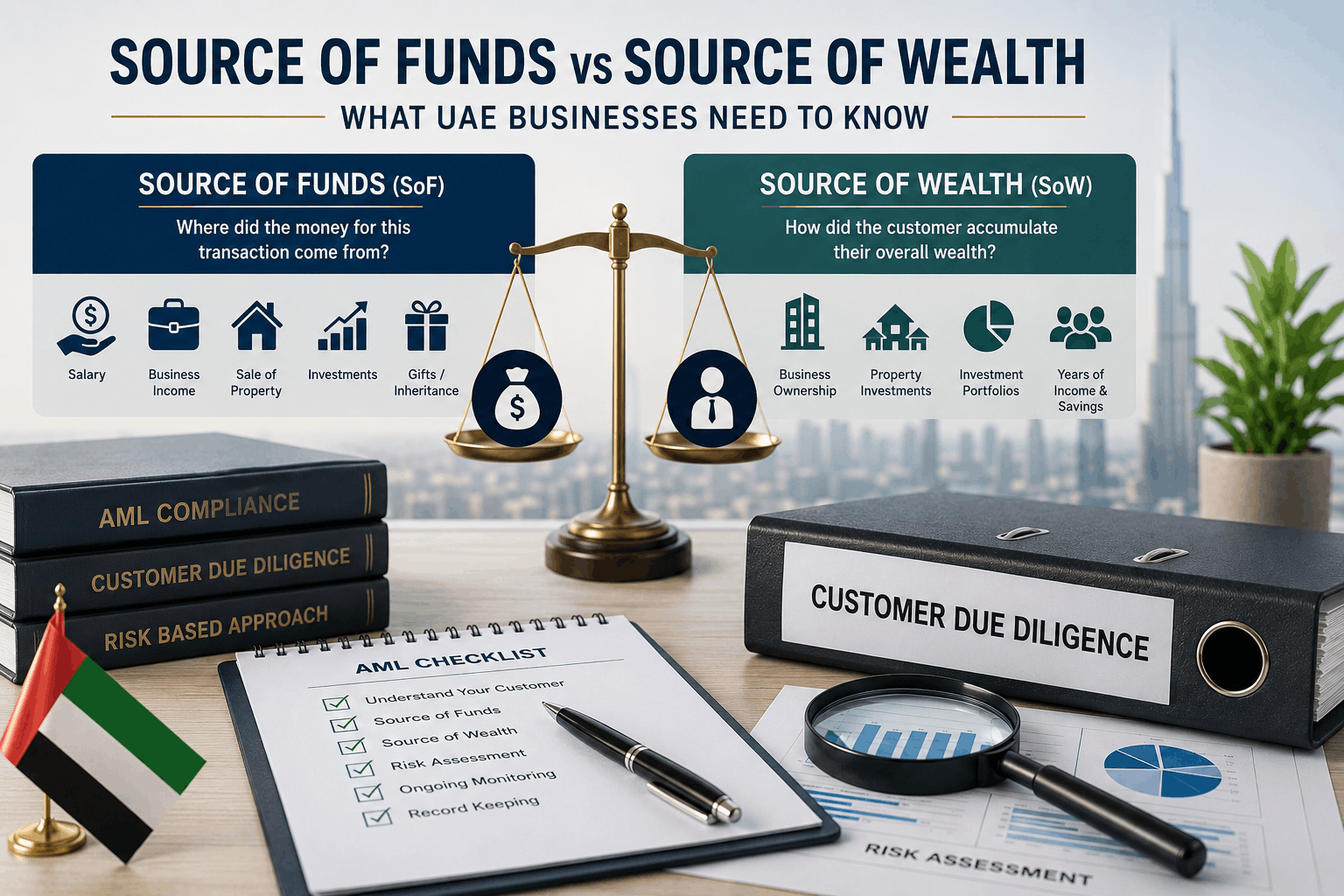
Although the terms are sometimes used interchangeably, they answer two different questions:
Source of Funds: Where did the money being used for this particular transaction or business relationship come from?
Source of Wealth: How did the customer accumulate their overall wealth?
Understanding this distinction helps regulated businesses develop a clearer picture of their customers, identify unusual financial activity and apply appropriate risk-based controls.
💰 What Is Source of Funds (SoF)?
Source of Funds refers to the origin of the specific money or assets involved in a transaction or business relationship.
For example, if a customer purchases a property, makes a large investment or carries out a significant transaction, the business may need to understand where the money used for that particular transaction originated.
Examples of Source of Funds may include:
- Salary or employment income
- Business income
- Personal savings
- Sale of property
- Sale of investments
- Dividend income
- Loan proceeds
- Inheritance
- Gifts
- Other legitimate sources
The objective is not simply to identify the bank account from which money was transferred. Businesses should seek to understand the underlying origin of the funds where required by the customer’s risk profile and applicable regulatory requirements.
🏦 What Is Source of Wealth (SoW)?
Source of Wealth takes a broader view.
It refers to how a customer accumulated their overall wealth or net worth over time.
Examples may include:
- Long-term employment and professional income
- Ownership of a successful business
- Business profits
- Property investments
- Investment portfolios
- Inheritance or family wealth
- Sale of a business
- Accumulated investment returns
- Other legitimate wealth-generating activities
Source of Wealth therefore helps the business understand the customer’s overall economic and financial background, rather than focusing only on one transaction.
🔍 Source of Funds vs Source of Wealth: What’s the Difference?
| Source of Funds (SoF) | Source of Wealth (SoW) | |
|---|---|---|
| Main question | Where did this specific money come from? | How did the customer accumulate their overall wealth? |
| Focus | Particular funds or transaction | Overall financial position |
| Example | AED 1 million came from the sale of a property | Customer accumulated wealth through 20 years of business ownership |
| Purpose | Understand the origin of funds being used | Understand how the customer’s overall wealth was generated |
| AML relevance | Helps assess whether specific funds appear legitimate and consistent with the customer’s profile | Helps assess whether the customer’s overall financial profile is reasonable and consistent |
The two concepts are closely connected but should not be treated as identical.
📊 Why Are Source of Funds and Source of Wealth Important for AML Compliance?
Understanding SoF and SoW allows regulated businesses to develop a more complete understanding of the customer.
They can help businesses:
- Understand the customer’s financial profile
- Assess whether transactions are consistent with that profile
- Identify unusual or unexplained activity
- Strengthen customer risk assessments
- Apply Enhanced Due Diligence where appropriate
- Identify potential money laundering or financial crime indicators
- Document the rationale behind compliance decisions
⚠️ When Should Businesses Examine Source of Funds or Source of Wealth?
The extent of SoF and SoW enquiries should follow a risk-based approach and the requirements applicable to the particular regulated entity.
Additional scrutiny may be appropriate when dealing with situations such as:
- Higher-risk customers
- Politically Exposed Persons (PEPs)
- High-value transactions
- Unusual or complex transactions
- Transactions inconsistent with the customer’s known profile
- Customers with complex ownership structures
- Significant cash activity
- Higher-risk geographical exposure
- Unexplained third-party payments
- Situations where the customer’s financial capacity is unclear
📄 What Documents Can Support Source of Funds?
The evidence required will depend on the nature of the funds and the customer’s risk profile.
Employment Income
- Salary certificate
- Payslips
- Bank statements
- Employment documentation
Business Income
- Financial statements
- Business bank statements
- Company ownership documents
- Contracts or invoices
- Dividend documentation
Sale of Property
- Sale and purchase agreement
- Property ownership documentation
- Bank statement showing receipt of proceeds
Investments
- Investment statements
- Brokerage statements
- Sale confirmations
- Dividend records
Inheritance
- Probate or inheritance documentation
- Court documentation where applicable
- Bank statements showing receipt
Loan
- Loan agreement
- Documentation identifying the lender
- Bank statements showing disbursement
The level of verification should be proportionate to risk.
📑 What Documents Can Support Source of Wealth?
Because Source of Wealth concerns the customer’s broader financial history, evidence may include a combination of documents.
Examples include:
- Employment and income history
- Business ownership records
- Audited financial statements
- Dividend records
- Property ownership records
- Investment portfolio statements
- Business sale agreements
- Inheritance documentation
- Bank and investment statements
- Other credible evidence explaining accumulated wealth
The objective should be to establish a reasonable and credible explanation of how the customer’s wealth was generated, taking the customer’s risk profile into consideration.
🚩 Source of Funds and Source of Wealth Red Flags
Businesses should pay particular attention when the information provided does not make economic or commercial sense.
Potential red flags may include:
- Transaction value significantly exceeding the customer’s apparent financial capacity
- Customer unwillingness to explain the origin of funds
- Documents inconsistent with the customer’s explanation
- Frequent unexplained third-party payments
- Complex movement of funds without a clear commercial purpose
- Sudden significant increases in wealth without reasonable explanation
- Funds originating from unrelated parties
- Inconsistent information regarding employment or business activities
- Funds moving through multiple jurisdictions without an apparent reason
- Source of Wealth inconsistent with the customer’s age, occupation or business profile
A red flag does not automatically mean money laundering has occurred. It indicates that further review may be necessary.
👤 Source of Funds and Source of Wealth for PEPs
Politically Exposed Persons can present elevated corruption and financial crime risks and therefore require additional risk-based controls.
Where applicable, businesses should take reasonable measures to establish the Source of Funds and Source of Wealth of PEPs and apply appropriate Enhanced Due Diligence.
The purpose is to determine whether the customer’s financial activity is reasonably consistent with their known legitimate income, business interests and accumulated wealth.
🏦 Importance for Financial Institutions
For banks, exchange houses, finance companies, payment service providers and other regulated Financial Institutions, understanding SoF and SoW can be an important part of customer risk management.
Financial Institutions may use this information to:
- Establish expected customer activity
- Assess customer risk
- Support EDD
- Evaluate unusual transactions
- Review higher-risk customers
- Strengthen ongoing monitoring
- Support investigation of potentially suspicious activity
Importantly, Source of Funds should not be confused with simply identifying the bank from which the transfer originated. The compliance question is often about how the customer legitimately obtained the money in the first place.
🏙️ Importance for UAE Real Estate Businesses
Source of Funds can be particularly relevant to real estate transactions because property purchases may involve substantial amounts.
Where appropriate under the applicable AML requirements and risk assessment, real estate brokers and agents may need to understand:
- Who is providing the purchase funds
- How those funds were generated
- Whether third parties are involved
- Whether the transaction is consistent with the customer’s financial profile
- Whether additional EDD is necessary
For example, merely seeing that AED 3 million was transferred from a customer’s bank account does not necessarily explain how the customer originally obtained the AED 3 million.
💎 Importance for Gold, Jewellery and Precious Metals Businesses
Dealers in Precious Metals and Stones (DPMS) can also encounter high-value transactions and customers from multiple jurisdictions.
Risk indicators may arise where:
- Transaction values appear inconsistent with the customer’s profile
- Large amounts are paid in cash
- Payments originate from unrelated third parties
- Customers provide unclear explanations about their business activities
- Transaction structures appear unnecessarily complex
- Funds originate from higher-risk jurisdictions
Understanding SoF and, where appropriate, SoW can therefore form an important component of EDD and customer risk management.
🔄 Source of Funds and Source of Wealth Are Not a One-Time Exercise
Customer circumstances can change.
A customer initially classified as lower risk may subsequently:
- Conduct substantially larger transactions
- Change business activities
- Enter new jurisdictions
- Become a PEP
- Change ownership structure
- Begin receiving funds from unexpected sources
Accordingly, SoF and SoW information may need to be revisited as part of ongoing monitoring, Re-KYC or event-driven reviews, depending on the customer’s risk and applicable requirements.
❌ Common Mistakes Businesses Should Avoid
Common weaknesses include:
- Treating Source of Funds and Source of Wealth as the same thing
- Recording only the originating bank account as Source of Funds
- Accepting customer declarations without appropriate review
- Collecting documents without assessing whether they make sense
- Failing to investigate inconsistencies
- Applying the same level of verification to every customer regardless of risk
- Failing to document the compliance team’s assessment
- Not updating information when the customer’s circumstances change
The purpose of SoF/SoW checks is not merely to collect documents. Compliance teams should evaluate whether the explanation and supporting information are reasonable and consistent with the customer’s known profile.
💼 How Professional AML Consultants Can Help
Properly incorporating Source of Funds and Source of Wealth procedures into an AML/CFT framework requires a clear risk-based methodology.
Professional AML consultants can assist businesses with:
- Developing SoF and SoW procedures
- Establishing CDD and EDD requirements
- Developing customer risk assessment methodologies
- Establishing documentary evidence requirements
- Developing PEP procedures
- Reviewing existing customer files
- Conducting AML Gap Analysis
- Conducting independent AML/CFT Audits
- Providing AML/CFT training
- Supporting regulatory inspection readiness
The procedures should be tailored to the organization’s sector, customers, transactions and regulatory obligations.
📌 Conclusion
Source of Funds and Source of Wealth are related but fundamentally different concepts. Source of Funds explains where the money involved in a particular transaction or relationship originated, while Source of Wealth explains how the customer accumulated their overall wealth.
For regulated UAE businesses, understanding both concepts can strengthen Customer Due Diligence, Enhanced Due Diligence, customer risk assessment and ongoing monitoring. More importantly, businesses should not treat SoF and SoW as simple documentation exercises—the information obtained should be assessed for credibility, consistency and alignment with the customer’s overall profile.
At AVS Lewis & Pecker Auditing, our AML/CFT compliance professionals assist Financial Institutions and DNFBPs with AML/CFT framework implementation, CDD and EDD procedures, Enterprise-Wide Risk Assessments, Customer Risk Assessments, AML Gap Analysis, independent AML/CFT Audits, AML/CFT training, MLRO support and ongoing compliance advisory services.
Our approach helps businesses establish practical, risk-based compliance procedures designed to meet applicable UAE regulatory requirements and strengthen their overall AML/CFT compliance framework.